
🍂 October Seasonal Produce Guide
What Happens When Autumn Walks Into an Indian Kitchen?
Your Monthly Kitchen Inspiration & What to Cook
This guide is part of my monthly Seasonal Produce Series — helping you cook with the seasons all year long.
📆 Seasonal Kitchen Calendar
🍂 October at a glance —
When Autumn Walks Into an Indian Kitchen
October arrives with autumn firmly at the door.
Apples, pears, pumpkins, winter squash, sweet potatoes, cauliflower, greens, and root vegetables begin filling
the markets, while a few of summer's peppers, tomatoes, and herbs may still linger.
For the Indian kitchen, this abundance opens up an entirely different way of thinking about fall cooking.
A pumpkin can simmer with coconut, mustard seeds, and curry leaves.
Sweet potatoes can meet cumin, chiles, and tamarind.
Apples can become a bright, spicy chutney.
Greens and cooler-weather vegetables can find their way into dals, poriyals, kootu, sabzis, and warming curries.
The season gives us the ingredients. Our kitchens decide what they become. 🌿
And October brings another rhythm to many Indian kitchens—the celebrations of Navaratri and Durga Puja,
with foods shaped by region, family, tradition, and devotion.
One table may hold bowls of sundal prepared as prasadam. Another may carry the aromas of a Durga Puja feast.
Somewhere else, October simply means the first deeply comforting curry simmering a little longer on the stove.
One season. Many traditions. Many tables. Many expressions of devotion.
Seasonal cooking doesn't require us to leave our culinary language behind.
We can take what the land around us is giving—and let the kitchens that raised us show us what to do with it. 🍂❤️
In this month's guide, we'll explore what's in season, how to choose and store October produce, Indian ways to cook
with autumn ingredients, useful pantry pairings, festival-inspired ideas, complete meals,
and recipes from the Stirred By Spice kitchen.
Let's see what happens when October's harvest walks into an Indian kitchen. 🍎🎃🌿
🍁 Seasonal Mood of the Month
October feels like autumn has finally settled into the kitchen.
The mornings are cooler. The light changes earlier. Market baskets grow heavier with apples,
pumpkins, squash, sweet potatoes, greens, and vegetables that seem
almost made for simmering, roasting, tempering, and sharing.
And in an Indian kitchen, those ingredients don't arrive alone.
They meet mustard seeds crackling in hot oil, curry leaves hitting the pan, coconut being grated,
lentils bubbling on the stove, tamarind soaking in a small bowl, and spices beginning to smell
just a little warmer than they did a month ago.
October also carries the rhythm of celebration.
Navaratri and Durga Puja remind us that food can be seasonal, regional, celebratory,
and devotional all at once.
There may be sundal prepared for prasadam, festival sweets appearing in the kitchen, meals shared after prayer,
or dishes whose meaning comes as much from when and with whom we eat them
as from what is in the pot.
And outside those festival days, ordinary October cooking has its own pleasure.
A pumpkin becomes curry.
A sweet potato meets cumin and chili.
An apple looks nervously at the mustard seeds. 😂🍎
And suddenly autumn tastes completely at home.
This is the month for letting the season change the ingredients without asking it to
change the identity of the kitchen. 🌿
Seasonal cooking in October isn't about recreating someone else's idea of autumn.
It's about allowing autumn to speak in a language we already know.
Seasonal mood:
Abundant • Warming • Festive • Grounded • Generous • Deeply Autumnal
🌿 Cook seasonally, without overthinking
Download my FREE Seasonal Produce Calendar (Monthly Series) —
a simple guide to what’s fresh, local, and worth cooking right now.
👉 [Download the free calendar]
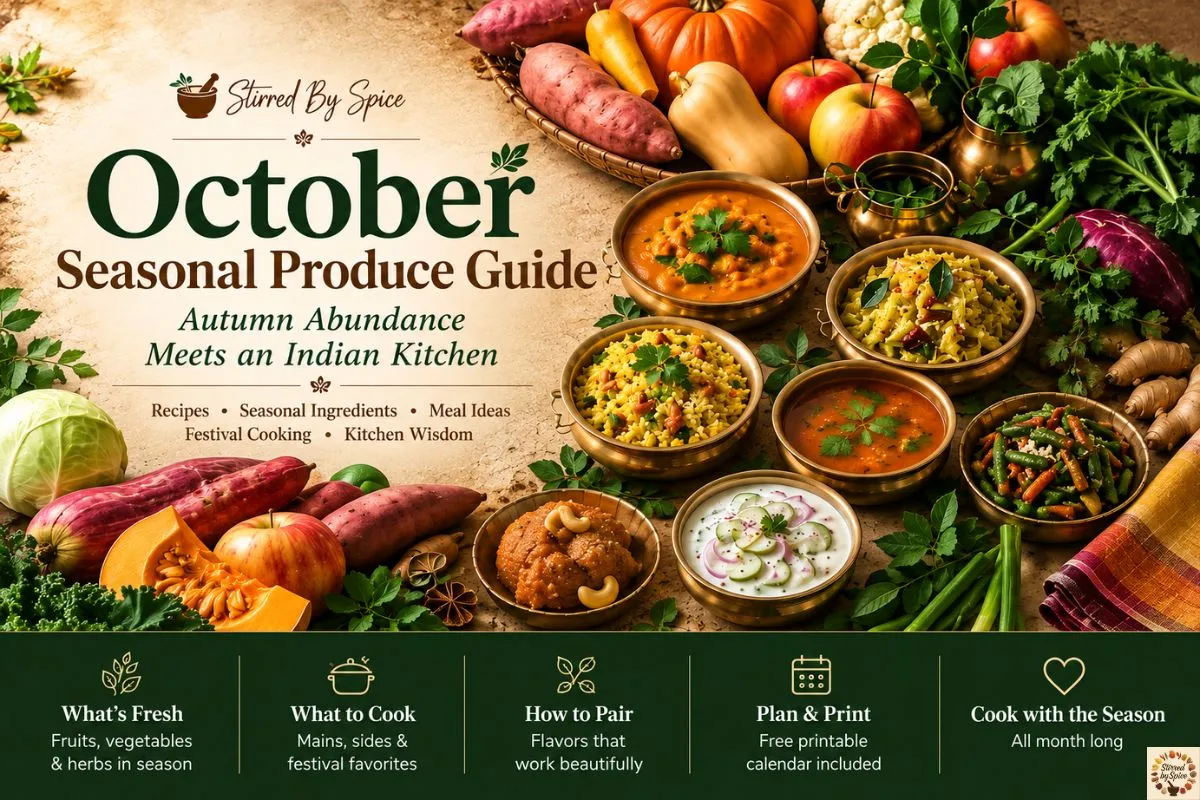
🍎 What’s in Season in October
Every season brings its own rhythm to the kitchen.
October is a month of abundance.
Autumn has settled into the market now, bringing apples, pears, pumpkins, winter squash,
sweet potatoes, leafy greens, cauliflower, broccoli, cabbage, carrots, beets,
and other cool-weather produce into their stride.
But an October basket doesn't tell us how those ingredients must be cooked.
A pumpkin can become a creamy soup—but it can just as naturally simmer with coconut,
mustard seeds, curry leaves, and spices.
Sweet potatoes can be roasted, tucked into a curry, seasoned into a poriyal, or
transformed into something sweet.
Apples don't have to stop at pie. They can meet ginger, jaggery, mustard seeds, chilies, and spices
and discover an entirely different life as chutney. 🍎
Seasonal cooking doesn't require abandoning one's culinary language.
For an Indian kitchen, October's harvest simply gives us new ingredients with which to speak it.
And this month, that everyday seasonal cooking also shares the kitchen with celebration.
Navaratri brings sundal, prasadam, festive sweets, and foods prepared with devotion. Durga Puja carries
its own regional food traditions and memories. Across India, the same season can arrive at many tables
in wonderfully different ways.
One season. One country of origin. Many traditions. Many tables. Many expressions of devotion.
That variety belongs in the October kitchen too.
A cool evening may call for dal, rasam, a warming curry, or vegetables simmered with coconut and spice.
A festival afternoon may find chickpeas being tempered for sundal.
And an ordinary basket of American autumn produce may quietly become something that tastes
unmistakably like home.
That is the pleasure of cooking in October:
You don't have to cook “American Fall food” to cook with an American autumn.
You can take what the land is giving you and let your own kitchen teach you what to do with it. 🍂❤️
🌿 Ayurvedic Kitchen Wisdom
Ayurveda offers another way of looking at the autumn market.
Instead of seeing an apple simply as an apple, or a bowl of lentils simply as dinner,
traditional Ayurvedic food wisdom also considers
the taste and qualities a food brings to a meal.
Ayurveda recognizes six tastes: sweet, sour, salty, bitter, pungent, and astringent.
But knowing the tastes isn't simply about naming what is on the tongue.
Traditional Ayurvedic thinking holds that different tastes carry different qualities—
some warming, some cooling; some light, some heavy; some moist, some dry.
One of its foundational ideas is often expressed simply as “like increases like.”
In everyday language, that gives us a lovely way to think about balance.
If everything on the plate brings the same quality, that quality becomes more pronounced.
Bringing different tastes and qualities together can create a meal
with greater balance and variety.
Ayurvedic physician and author Dr. Suhas Kshirsagar teaches that all six tastes have a place in the diet,
while their proportions may vary according to the individual and circumstance.
We don't need to become experts in the doshas to begin noticing what this teaches us as cooks.
October gives us plenty to observe.
🍠 Sweet potatoes, pumpkin, squash, and root vegetables bring natural sweetness.
🥬 Dark leafy greens introduce bitterness.
🫘 Beans and lentils contribute astringency.
❤️ Cranberries and pomegranate bring tart and astringent notes.
🌶️ Mustard, cumin, black pepper, chilies, onion, and warming spices introduce pungency and warmth.
And an Indian kitchen often brings several of these tastes together quite naturally.
A naturally sweet pumpkin can meet mustard seeds and chili.
Earthy lentils can meet bitter greens and warming cumin.
Tart cranberries can meet jaggery, mustard, and spice in a thokku.
The ingredient may be seasonal. The wisdom lies in how we bring it to the plate.
Perhaps that is the most useful invitation Ayurveda offers the everyday cook: pay attention.
Not simply What am I eating? but:
What tastes are here? What qualities are here? What might balance them?
You don't have to memorize an entire system to begin noticing.
Sometimes awareness is the beginning. 🌿
🌿 October's Seasonal Stars
These are the ingredients that make October feel unmistakably like autumn—
crisp fruits, sturdy greens, roots and squash,
ready to find a new home in the Indian kitchen.
🎃 Vegetables
October’s market basket has settled into autumn now. The tender produce of summer begins giving way
to vegetables that roast, simmer, soften, and take beautifully to spice.
And this is where an Indian kitchen has tremendous fun with the season.
🎃 Pumpkin & Winter Squash — Wonderful in sambar, kootu, curries, poriyal, dal and
coconut-based preparations.
🍠 Sweet Potatoes — Naturally sweet and wonderfully receptive to cumin, chili, chaat masala,
mustard and warming spices.
🥕 Carrots — Lovely in poriyal, kurma, sambar, pulao, soups and halwa.
🥦 Cauliflower — Roast it with spices, tuck it into curries, add it to kurma or turn it into a dry sabzi.
🥬 Leafy Greens — Spinach, kale, chard and mustard greens are increasingly welcome in dal, keerai,
kootu and stir-fries.
🥔 Potatoes — Made for masala, curries, podimas, roast potatoes, chaats and countless
comforting autumn meals.
🥬 Cabbage — Humble, economical and excellent in poriyal, pakoda, kootu, curries
and quick stir-fries.
🌱 Brussels Sprouts — Perhaps not traditionally Indian, but very happy roasted or stir-fried
with mustard seeds, curry leaves and coconut. 😉
🫘 Green Beans — Still appearing in many markets and perfect for poriyal, usili, sambar
and coconut-forward preparations.
✨ Vegetable Ingredient Spotlight Tip:
🎃 Pumpkin
Why it shines now:
Pumpkin is one of October's great gifts, but its possibilities extend far beyond pie and pumpkin spice.
Its gentle sweetness takes beautifully to chilies, cumin, mustard seeds, curry leaves, tamarind
and coconut, making it wonderfully at home in an Indian kitchen.
Pumpkin and squash already appear naturally in Indian preparations, including curries and chutneys.
Best ways to use this month:
Pumpkin Kootu
Pumpkin Poriyal
Pumpkin Curry
Pumpkin Dal
Pumpkin Chutney
Roasted Masala Pumpkin
Pumpkin Erissery
Kitchen pairing:
Pumpkin loves mustard seeds, cumin, curry leaves, coconut, ginger, green chilies, dried red chilies,
tamarind, jaggery, turmeric and warming spices.
Cook's wisdom:
Choose pumpkins or winter squash that feel heavy for their size and have firm, unblemished skin.
Pumpkin's natural sweetness benefits from contrast—a little heat, acidity or bitterness keeps
savory preparations balanced rather than overly sweet.
Learn more:
→ How to Choose, Store & Cook with Pumpkin & Winter Squash
🍎 Fruits
October fruit brings crispness, tartness and sweetness to the market—
and an invitation to look beyond the pie dish.
🍎 Apples — Eat them fresh, certainly—but also let them wander into chutney, pachadi and
gently spiced savory preparations.
🍐 Pears — Beautiful with ginger, cardamom and warming spices, and equally comfortable
in chutneys and sweet dishes.
🍒 Cranberries — Tart, jewel-bright and absolutely magnificent when introduced to mustard seeds,
sesame oil, tamarind, jaggery and chili.
🔴 Pomegranates — Bright, tart-sweet and wonderful over chaat, yogurt dishes, salads and festive foods.
🍇 Grapes — Lovely fresh and useful in pachadi, raita, salads and festive preparations.
🟠 Persimmons — A beautiful late-autumn fruit worth experimenting with in chutneys, salads
and gently spiced preparations.
✨ Fruit Ingredient Spotlight Tip:
🍎 Apples.
Why it shines now:
October belongs to apples—but they don't have to belong only to pies, crisps and cider.
Their balance of sweetness and acidity makes them surprisingly comfortable with mustard seeds,
chilies, ginger and warming spices.
South Indian-style apple thokku is one lovely example of apples crossing easily from the fruit bowl
into the savory kitchen.
An October apple may arrive expecting cinnamon and pie crust. Then it notices the mustard seeds. 😂🍎
Best ways to use this month:
Apple Chutney
Apple Thokku
Apple Pachadi
Spiced Apple Compote
Apple Raita
Apple Halwa
Apple Kheer
Kitchen pairing:
Apples pair beautifully with ginger, mustard seeds, curry leaves, cinnamon, cardamom,
cloves, black pepper, chilies, tamarind, lemon, jaggery and nuts.
Cook's wisdom:
Choose the apple according to what you're making. Firmer, tart-sweet apples hold their shape better
in cooked savory dishes, while softer or sweeter varieties work beautifully when you want the fruit
to cook down into chutney, thokku or compote.
Taste before adding sugar or jaggery—the apple may already be bringing plenty of sweetness.
Learn more:
→ How to Choose, Store & Cook with Apples
You don't need a different harvest.
Sometimes you simply need to ask a familiar ingredient a different question. ❤️
🌿 Fresh Herbs & Aromatics
As autumn settles in, the herbs and aromatics in the kitchen begin doing a little more than adding freshness.
They bring fragrance, warmth and depth to the foods we naturally begin craving.
🌿 Curry leaves - Fragrant and unmistakably South Indian; essential for tempering, chutneys, podi,
dals, curries and giving October produce a familiar culinary voice.
🌿 Cilantro — For chutneys, rasam, curries, rice dishes and finishing almost
everything with freshness.
🌿 Mint — Still lovely in chutneys, raita, buttermilk and herb-forward rice dishes.
🟡 Fresh Turmeric - When you find the fresh root, its earthy, gently pungent character is lovely
in pickles, thokku, chutneys and warming autumn cooking.
🌶️ Fresh Green Chilies — The little thread of heat running through chutneys, tempering,
poriyal and everyday cooking.
🫚 Ginger — Bright, warming and increasingly welcome as cooler days call for fragrant teas,
rasam, dals, curries and gently spiced autumn cooking.
✨ Herb Ingredient Spotlight Tip:
🌿 Curry leaves
Why it shines now:
Curry leaves aren't an October ingredient in the same seasonal sense as pumpkin or apples—
and I think we should be precise about that.
They belong here because they show us how an Indian kitchen receives the season.
A few curry leaves crackling in hot oil can connect October's squash, roots, lentils and even fruit chutneys
to a familiar culinary vocabulary.
And curry leaves needn't remain a background aromatic: South Indian kitchens also make them
the star of chutney, thogayal and podi.
How to use this month:
Karuveppilai Chutney / Thogayal
Curry Leaf Podi
Karuveppilai Sadam
Curry Leaf Kuzhambu
Pumpkin or Squash Curry with Curry Leaves
Apple or Cranberry Thokku with Curry Leaves
Kitchen pairing:
Curry leaves love mustard seeds, urad dal, dried red chilies, green chilies, coconut, tamarind,
ginger, turmeric, black pepper, cumin, lentils and sesame or coconut oil.
Cook's wisdom:
Fresh leaves give the brightest aroma. Add them carefully to hot oil during tempering—
they can splutter as their moisture hits the oil.
Let them sizzle briefly until fragrant rather than scorching them.
And don't think of curry leaves as merely something to fish out at the end:
when ground into chutney, thogayal or podi, the leaf itself becomes part of the dish.
Learn More :
→How to Choose, Store & Cook with Curry Leaves
The pumpkin may be new to the season. The apple may be wondering what happened to its pie.
But the curry leaves know exactly what to do with both. 🌿😂❤️
🌿 Note: Some of these ingredients link to deeper kitchen notes — for those who like to learn as they cook.
🌿 Keep October Close at Hand
You've just explored what's in season and a few simple ways
to bring October's harvest into your Indian kitchen.
If you'd like something easy to keep nearby,
I've created a free October Seasonal Produce Calendar
with the month's fruits, vegetables, herbs, and simple ideas for what to cook with them.
Keep it on your fridge or save it to your phone, and let it take one small decision off your plate
when you're wondering what to cook.
Delivered instantly to your inbox — simple, printable, and easy to use.
🛒 Smart Shopping Tips
Choose October produce for freshness, flavor, and how you actually plan to cook it.
October brings sturdy roots, winter squash, crisp orchard fruit, cool-weather greens, and vegetables
made for the warmer, slower dishes we begin craving now.
A thoughtful market basket doesn't need everything that's in season—just ingredients with
somewhere useful to go once they reach your kitchen.
🎃 Winter Squash & Pumpkin — Look for squash that feels heavy for its size, with firm,
unblemished skin and an intact, dry stem.
🍠 Sweet Potatoes — Choose firm sweet potatoes with smooth skin and no soft spots,
deep cuts, or signs of sprouting.
🥦 Cauliflower & Broccoli — Choose firm, compact heads with fresh-looking leaves;
avoid excessive browning, yellowing, or soft spots.
🥬 Leafy Greens — Look for crisp, vibrant leaves without yellowing, wilting,
or excessive moisture.
🥕 Carrots & Root Vegetables — Choose firm roots that feel heavy and crisp rather than
limp, shriveled, or soft.
🥬 Cabbage — Look for dense, firm heads with crisp leaves and minimal bruising
or discoloration.
🍎 Apples — Choose firm fruit with smooth skin and no soft spots or bruising.
🍐 Pears — Choose firm, unblemished pears and let them ripen at home; for ripe pears,
look for a slight give near the stem.
🍒 Cranberries — Look for plump, firm berries with deep, even color; discard any
that are soft or shriveled.
🔴 Pomegranates — Choose fruit that feels heavy for its size with firm skin; minor surface
marks are fine, but avoid soft or damaged areas.
🍇 Grapes — Look for plump grapes firmly attached to green, flexible-looking stems
rather than dry, brittle ones.
🟠 Persimmons — Choose according to variety: Fuyu should be firm and richly colored,
while Hachiya needs to become very soft before eating.
🌿 Curry Leaves — Choose glossy, deep-green leaves that look fresh and flexible rather
than yellowed, dry, or brittle.
🌿 Cilantro & Mint — Choose vibrant bunches with crisp leaves and stems and
no yellowing or sliminess.
🌶️ Green Chilies — Choose firm, glossy chilies with taut skin and fresh-looking stems.
🫚 Ginger — Look for firm, smooth rhizomes that feel juicy rather than dry, shriveled, or fibrous.
🟡 Fresh Turmeric — Choose firm, plump rhizomes with smooth skin, avoiding pieces that
are shriveled, excessively dry, or soft.
👉 🌿 Continue Exploring: How to Choose, Store & Cook with Seasonal Produce
✨ Smart Storage Tips
🎃 Winter Squash & Pumpkin — Store whole, uncut squash in a cool, dry, well-ventilated place.
Once cut, refrigerate tightly covered and use within several days.
🍠 Sweet Potatoes — Store in a cool, dark, dry, well-ventilated place rather than the refrigerator.
Keep them away from excess moisture.
🥦 Cauliflower & Broccoli — Refrigerate unwashed and loosely wrapped or in a breathable produce bag.
Keep dry and use while the florets are still firm.
🥬 Leafy Greens — Remove damaged leaves, keep the greens dry, and refrigerate with a paper towel
in a container or produce bag to absorb excess moisture.
🥕 Carrots & Root Vegetables — Refrigerate in the crisper and keep them from drying out.
Remove leafy tops before storing carrots or beets for longer keeping.
🥬 Cabbage — Keep whole and unwashed in the refrigerator crisper. Once cut, wrap the remaining
cabbage well and refrigerate.
🍎 Apples — Keep a few at room temperature for immediate eating, but refrigerate larger quantities
to preserve their crispness longer.
🍐 Pears — Ripen at room temperature, then move to the refrigerator once ripe to slow further softening.
🍒 Cranberries — Refrigerate dry and unwashed in their original or a breathable container.
Freeze extras for longer storage—they freeze beautifully.
🔴 Pomegranates — Whole pomegranates keep well in the refrigerator; once opened, refrigerate
the arils in a covered container.
🍇 Grapes — Refrigerate unwashed and wash only before eating; keeping them dry helps them last longer.
🟠 Persimmons — Let firm fruit ripen at room temperature as needed. Once ripe—especially very soft
Hachiya persimmons—refrigerate and use promptly.
🌿 Curry Leaves — Refrigerate dry leaves in a lined airtight container or bag. For longer storage, freeze clean,
thoroughly dried leaves and use them straight from frozen.
🌿 Cilantro & Mint — Trim the stems and store like a small bouquet in a little water in the refrigerator,
loosely covered where practical.
🌶️ Green Chilies — Refrigerate dry in a container or produce bag; remove any spoiled chilies promptly
so they don't affect the rest.
🫚 Ginger — Keep fresh ginger dry and refrigerated for everyday use; freeze extra ginger if you won't use it soon.
🟡 Fresh Turmeric — Refrigerate dry and loosely wrapped or in a container; freeze extra whole roots
for longer keeping.
💛 Kitchen Wisdom:
Good storage isn't about keeping produce forever. It's about helping what you brought home stayat its best long enough to become dinner.
🍽️ 5 Recipes to Cook This Month
If you're wondering where to begin, start with these October favorites.
Each one takes something from the month's harvest and lets it wander a little further
into the Indian kitchen—from pumpkin and sweet potatoes
to tart cranberries and orchard apples.
1️⃣ 🎃 Pumpkin Khoddel
Sweet • Tangy • Coconut-Rich • Warming
Tender pumpkin is simmered with tamarind and jaggery, then folded into a fragrant paste of roasted coconut,
Byadgi chillies and warm spices. Finished with a crackling garlic, mustard and curry-leaf tadka,
it is the kind of deeply comforting curry that seems made for an October bowl of hot rice.
October stars: Pumpkin • Coconut • Tamarind • Curry Leaves
🥥 Kitchen note: Pumpkin's sweetness works especially well against mustard seeds,
curry leaves, chilies, and coconut.
🍳 Helpful Kitchen Equipment: A heavy-bottomed kadai or saucepan helps the pumpkin
soften gently without breaking down too quickly.
2️⃣ 🍠 Sweet Potato Poriyal
Earthy • Savory • Weeknight-Friendly
Sweet potatoes don't need marshmallows to know it's autumn. 😂❤️ Tossed with mustard seeds, curry leaves,
chilies, and coconut, they become a simple South Indian-style side dish where sweetness,
heat, and savory tempering balance one another.
October stars: Sweet Potatoes • Curry Leaves • Green Chilies • Coconut
💛 Kitchen note: A little heat or acidity keeps sweet potatoes from tasting overly sweet in savory preparations.
🍳 Helpful Kitchen Equipment: A wide kadai or skillet gives the cubes enough room to cook evenly without becoming mushy.
3️⃣ 🍒 Cranberry Thokku
Tart • Spicy • Sweet-Savory • Indian-American
Here is October crossing cultures in one little jar. Tart cranberries meet sesame oil, mustard seeds,
tamarind, jaggery, and spice in a bold relish that feels unmistakably Indian while celebrating
one of autumn's most distinctly American fruits.
October stars: Cranberries • Ginger • Chilies • Mustard Seeds
❤️ A little SBS philosophy in a jar: The ingredient may come from one landscape; the culinary language
can come from another.
🍳 Helpful Kitchen Equipment: A heavy-bottomed saucepan or kadai helps the cranberries cook down
slowly without scorching as the thokku thickens.
4️⃣ 🥦 Cauliflower & Peas Curry
Warming • Everyday • Pantry-Friendly
Cool-weather cauliflower takes beautifully to cumin, ginger, chilies, turmeric, and warming spices.
Add peas for sweetness and color, and you have the sort of everyday vegetable curry that turns
October produce into an easy weeknight dinner.
October stars: Cauliflower • Ginger • Green Chilies • Fresh Turmeric, if using
🌿 Kitchen note: Keep a little bite in the cauliflower rather than cooking it until completely soft;
the contrast makes the finished curry much more satisfying.
🍳 Helpful Kitchen Equipment: A wide kadai gives the cauliflower enough surface area to cook evenly
while keeping its shape.
5️⃣ 🍎 Eggless Caramel Apple Cake
Warm • Spiced • Autumn Baking • Eggless
And after asking the poor October apple to survive mustard seeds, thokku and pachadi...
we finally give it some cake. 😂🍎❤️
Tender apples, warm autumn spices, and caramel come together in an eggless cake that lets
October's orchard fruit have the more traditional fall moment it was probably expecting all along.
October stars: Apples • Cinnamon • Warming Spices
🍎 Kitchen note: Choose an apple with enough tartness to balance the sweetness of the caramel
and enough structure to hold up during baking.
🍳Helpful Kitchen Equipment: A sturdy cake pan and cooling rack help the cake bake evenly and cool
without becoming soggy underneath.
These aren't elaborate ideas—just five ways to notice what October is offering and let the season
find its way into your own kitchen: a comforting curry, a simple vegetable side,
a spoonful of thokku, or something warm and sweet with tea.
The harvest may change with the season. The language of the kitchen can still be your own. 🍂❤️
🍽️ Quick Weeknight October Meals
Cooler October evenings call for meals that feel warming and satisfying without turning
an ordinary weeknight into a project.
These simple combinations make good use of October produce while keeping dinner nourishing,
flavorful, and manageable when the day has already been full.
🎃 Pumpkin Khoddel + Rice
Gentle, comforting, and wonderfully complete.
→ Serve pumpkin khoddel over hot rice with a little pickle or papad on the side for an easy bowl of
lentils, vegetables, coconut, and comfort.
🍠 Sweet Potato Poriyal + Dal + Rice
Earthy, savory, and deeply satisfying.
→ Pair the sweet potato poriyal with your favorite dal and steamed rice for a simple meal
where the sweetness of the vegetable meets something warm and savory.
🥦 Cauliflower & Peas Curry + Jeera Rice
Warming, aromatic, and weeknight-friendly.
→ Let the cauliflower curry do the heavy lifting and pair it with fragrant jeera rice for a dinner
that feels much more elaborate than the effort involved.
Simple, nourishing, and October-festival friendly.
→ A bowl of lightly tempered chickpeas or another sundal alongside rasam rice makes an easy meal—
and quietly nods toward the foods appearing in many kitchens during Navaratri.
🥬 Dal + October Vegetable Poriyal
Simple • Nourishing • Endlessly adaptable
→ Pair your favorite dal with cabbage, carrots, beets, leafy greens, cauliflower, sweet potato, or another
October vegetable that followed you home from the market.
🌿 October weeknight cooking doesn't need to be complicated. Start with what followed you home from the market,
add something already familiar from your pantry, and let dinner grow from there.
🌺 Cook for Navaratri
October often brings another kind of season into the Indian kitchen—the season of festival cooking.
During Navaratri and Durga Puja, what appears on the table can look wonderfully different
depending on region, family, community, and tradition.
In many South Indian homes, Navaratri may bring bowls of sundal prepared as prasadam,
along with payasam and simple festive foods
offered with devotion before being shared.
Elsewhere, Durga Puja carries entirely different culinary traditions—
celebratory meals, sweets, bhog, and regional dishes
that tell another story of devotion through food.
One season. Many traditions. Many tables. Many expressions of devotion.
There is no need for this guide to make those traditions look alike.
That difference is part of the beauty.
Whether you are cooking for a festival, preparing an offering, feeding family and friends,
or simply curious about the foods that accompany these celebrations,
here are a few dishes to begin exploring.
🥥 Kondakadalai Sundal / Black Chickpea Sundal —
coconut, mustard seeds, curry leaves and chilies
🌼 White Chickpea Sundal / Chana Sundal
🫘 Green Gram / Pasi Payaru Sundal
🫛 Green Peas Sundal / Pattani Sundal
🫘 Karamani Sundal / Black-Eyed Pea Sundal
🥭 Mango Sundal — when raw mango is available
🥥 Coconut Rice / Thengai Sadam
🍋 Lemon Rice / Elumichai Sadam
🥛 Semiya Payasam
🌾 Aval Payasam
🥥 Coconut Ladoo
🌰 Rava Ladoo
🟡 Paruppu Payasam / Moong Dal Payasam
🫘 Paruppu Vadai/Masala Vadai
🌿 The Navaratri Sundal Bowl
One of the loveliest things about Navaratri cooking is how many possibilities can begin with
something as humble as a bowl of legumes.
Chickpeas one day. Green gram another. Black-eyed peas or green peas on another.
Across the nine days, the humble sundal bowl can take on many forms.
Then comes the familiar South Indian transformation—mustard seeds crackling in oil, curry leaves, chilies,
perhaps a little asafoetida, and fresh coconut scattered through at the end.
Simple food. Nourishing food. Food made sacred by intention. 🌿🙏
Festival cooking is seasonal cooking of another kind—guided not only by what the earth is offering,
but by memory, tradition, and the rhythms of the calendar. 🌿🙏
🌺 Cook for Durga Puja
Durga Puja was one of those celebrations I came to know more deeply after moving to America.
And perhaps that is one of the unexpected gifts of living away from India: sometimes distance introduces us
to parts of our own country we had never experienced closely before.
My first Durga Puja celebration here introduced me not only to the festival, but to its food—
and to something that surprised me.
Kosha Mangsho.
Until then, eating meat in the context of a puja was completely unfamiliar to me.
I had grown up understanding festival and temple food through a very different South Indian culinary tradition.
But there, at Durga Puja, I encountered another expression of devotion.
Different region. Different customs. Different food.
And instead of making India feel less familiar, it somehow made India feel larger.
I loved discovering India in America. ❤️
That memory has stayed with me because it taught me something I still find beautiful
about Indian food traditions: devotion does not always arrive at the table wearing the same clothes.
During Durga Puja, food may include bhog such as khichuri, labra and payesh,
alongside the sweets and celebratory dishes associated with the festival
and, in many families and communities, beloved Bengali non-vegetarian dishes as well.
The table can tell us where we come from, but it can also introduce us to somewhere we have never been.
One Goddess. Many regions. Many kitchens. Many ways of gathering around Her. 🌺🙏
Here are some dishes through which you might begin exploring
the food traditions surrounding Durga Puja.
🍚 Bhoger Khichuri
🥬 Labra
🍆 Begun Bhaja
🍅 Tomato Khejur Chutney
🥣 Payesh
🥛 Mishti Doi
⚪ Rasgulla / Rosogolla
🟠 Sandesh
🐟 Bengali Fish Curry / Macher Jhol
🐐 Kosha Mangsho
🍗 Bengali-style Chicken Curry
I knew Devi through one culinary language.
Then, in America, I met another. 🌺❤️
🌺 Beyond the Recipes — Stories of the Season
Food can tell us what is cooked for a festival.
Stories can help us understand why it matters.
If you'd like to wander a little deeper into the traditions, memories, and meanings behind these celebrations,
these stories from the Stirred By Spice kitchen continue the journey beyond the recipe.
🍂 From My Kitchen This October
Let autumn bring the ingredients.
Let your kitchen decide what they become.
Why October Cooking Feels Special
October feels different from September.
The season is no longer standing politely at the doorway.
Autumn has come inside. 🍂
Apples and pears fill market baskets. Pumpkins and winter squash seem to appear everywhere.
Sweet potatoes, cauliflower, cabbage, greens, carrots and beets begin asking for
a little more room in the kitchen.
The evenings cool down.
A pot simmering on the stove begins to sound especially inviting.
And this is where October becomes interesting to me.
Because the season may change the ingredients, but it does not have to change the language of the kitchen.
Pumpkin doesn't have to become pie.
Sweet potatoes don't have to arrive beneath marshmallows.
And that perfectly innocent American apple may discover that life beside the
mustard seeds is actually rather exciting. 😂🍎
It can become chutney.
Pumpkin can meet coconut, chilies and curry leaves.
Sweet potatoes can take beautifully to cumin, mustard seeds, tamarind or spice.
Cool-weather greens and vegetables can disappear into dals, kootu, poriyal, sabzis and curries
that feel completely at home on an October evening.
That is what I love about seasonal cooking.
We don't have to borrow someone else's idea of what autumn should taste like.
We can look at what the land around us is giving, bring it home, and cook it
through the culinary language we already know.
Instead of asking,
"What am I supposed to cook in fall?"
perhaps October invites another question:
"What happens when I let autumn wander into my kitchen?" 🍂🌿
Sometimes the most interesting recipes begin right there.
🌿 October's kitchen rhythm feels like:
bringing pumpkin, squash and sweet potatoes into curries, dals and vegetable dishes
turning apples, pears and cranberries toward chutneys, thokku and spice
welcoming cauliflower, cabbage, greens and root vegetables back into regular rotation
letting soups, rasam, dal and gently simmered curries linger a little longer on the stove
cooking with the foods and traditions that October's festivals bring back to the table
allowing an American autumn to feel completely at home in an Indian kitchen
🌼 A gentle reminder
Seasonal cooking doesn't require abandoning one's culinary language.
The farmers' market can tell us what is abundant.
The weather can tell us what might feel good today.
Tradition, memory, curiosity and taste can tell us what to do with it.
There is no rule saying October must taste like pumpkin spice.
Sometimes October tastes like mustard seeds crackling in oil,
curry leaves hitting the pan,
tamarind soaking in a bowl,
coconut being grated—
and an apple wondering what on earth happened to its plans for pie. 😂🍎
Let the season change the ingredients.
Your kitchen can keep its own voice. 🍂❤️
🧺 Pantry Ingredients to Stock This Month
🧂 Your October Pantry Pairings
October's market basket may look unmistakably American, but the pantry beside it
can still feel wonderfully familiar.
Pumpkins, winter squash, sweet potatoes, apples, pears, cauliflower, cabbage, greens,
and root vegetables all become remarkably versatile once they meet the ingredients
already at home in an Indian kitchen.
Keeping a few familiar staples nearby means October's produce can move easily into everyday curries,
dals, poriyals and chutneys—as well as the festival foods that return to our kitchens this month.
🥥 Fresh or frozen coconut
🌿 Curry leaves
🌱 Cilantro
🌶️ Green chilies
🧅 Onions
🧄 Garlic
🫚 Ginger
🌾 Tamarind
🍯 Jaggery
🟡 Mustard seeds
✨ Cumin seeds
🟤 Sesame seeds
🫘 Urad dal
🌼 Chana dal
🥜 Peanuts & roasted gram
🫙 Ghee
🌾 Rice
🥥 Coconut oil
🌿 Coriander seeds
❤️ Dried red chilies
🌿 Cardamom
🥜 Cashews
🫘 Chickpeas & other whole legumes
👉 If you’d like help understanding how these ingredients work together — without memorizing recipes —
my Indian Spices & Masala Guide walks you through it gently.
🍐 October Pantry Pairings
These pantry staples + September's seasonal produce = simple meals that move easily between
late summer and early autumn.
🎃 Pumpkin / Winter Squash → coconut + cumin + curry leaves
🍠 Sweet Potatoes → cumin + mustard seeds + chili
🍎 Apples → ginger + jaggery + mustard seeds
🍐 Pears → ginger + cardamom + jaggery
🥬 Leafy Greens → garlic + cumin + coconut
🥦 Cauliflower → cumin + coriander + chili
🥬 Cabbage → coconut + mustard seeds + curry leaves
🥕 Carrots → coconut + mustard seeds + curry leaves
Beets → coconut + cumin + mustard seeds
🍒 Cranberries → tamarind + jaggery + chili
🥔 Potatoes → cumin + mustard seeds + curry leaves
Seasonal cooking becomes easier when the pantry doesn't need to change completely
every time the produce does.
The same handful of familiar ingredients can meet pumpkin one week, apples the next, and cauliflower
the week after—and send each of them in an entirely different direction.
Once you begin recognizing those relationships, cooking becomes less about finding the perfect recipe and more
about looking at what is in front of you and thinking:
“I know what I can do with that.” 🌿❤️
👉 If you’d like help understanding how these ingredients work together — without memorizing recipes —
my Indian Spices & Masala Guide walks you through it gently.
🍗 🐟 Beyond Vegetarian: Meat & Seafood Ideas
October's Indian kitchen holds many traditions at once.
For some families, festival cooking this month may mean vegetarian meals, sundal, sweets,
and foods prepared as prasadam.
For others, particularly during Durga Puja, the table may also include deeply spiced meat and fish dishes
shaped by regional and family traditions.
There is no single October Indian table.
And perhaps that is one of the loveliest things about discovering India's food traditions—the same season
of devotion can be expressed through wonderfully different kitchens.
🐐 Kosha Mangsho
Slow-Cooked • Deeply Spiced • A Durga Puja Memory
I first tasted Kosha Mangsho at a Durga Puja celebration after moving to America.
Until then, eating meat in the context of a puja was completely unfamiliar to me. But that meal introduced me
to another Indian tradition—one I hadn't grown up with, yet could appreciate and understand through
the people who welcomed me to their table.
I fell in love with Kosha Mangsho that day, and somehow the two have remained connected in my memory
ever since: Durga Puja and that deeply spiced, slow-cooked mutton curry.
It became one of those unexpected gifts of immigrant life:
I came to America—and discovered another piece of India. ❤️
→ Serve with luchi, paratha, pulao, or steamed rice, with a simple seasonal vegetable alongside.
October connection: Durga Puja • warming spices • slow cooking • shared celebration
🌶️🍗 Pepper Chicken
Peppery • Warming • Weeknight Comfort
Black pepper, ginger, garlic, and warming spices give this chicken dish exactly the kind of heat that
begins to feel especially welcome when October evenings turn cooler.
→ Serve with steamed rice, ghee rice, dosa, or chapati, with a simple cabbage, cauliflower, or greens side.
Seasonal pairing: Black pepper + ginger + garlic + cool-weather greens
Fragrant • Herbaceous • Comforting
Fresh cilantro and mint give this chicken kurma its vibrant character, making it a lovely way to
use September herbs
while they're still plentiful.
→ Serve with ghee rice, appam, neer dosa, or steamed rice.
Seasonal pairing: Mint + cilantro + coconut + green chilies
Tangy • Coconut-Rich • Coastal Comfort
Coconut, tamarind, and warming spices bring the flavors of the coast to the October table—
a reminder that autumn comfort doesn't have to mean
leaving our own culinary language behind.
→ Serve with steamed rice or neer dosa, alongside sautéed greens, cabbage, or
a simple seasonal vegetable.
Seasonal pairing: Coconut + tamarind + curry leaves + seasonal vegetables
Fragrant • Spiced • Celebration-Worthy
A deeply aromatic mutton biryani layered with the bold spices of Chettinad cooking feels
right at home at an October table—warming enough for
a cool evening and special enough for a gathering.
→ Serve with onion raita, cucumber raita, or a simple vegetable side to balance the richness.
Seasonal pairing: Warming spices + mint + cilantro + onion
October reminds us that seasonal cooking isn't defined by whether a meal is vegetarian or non-vegetarian.
Nor does an Indian festival table look exactly the same from one region, family, or tradition to another.
One kitchen may temper chickpeas for sundal. Another may slowly cook Kosha Mangsho for a Durga Puja gathering.
Somewhere else, fish curry, chicken, vegetables, rice, sweets, and dishes passed down through generations
may all become part of how the season is remembered.
The ingredients change. The traditions change. The tables change.
What remains is the way food gathers people around them. ❤️
🍽️ Build a Complete October Meal
Not sure what to cook together?
October's market basket gives us plenty to work with—pumpkin, sweet potatoes, cauliflower, cabbage,
greens, apples, pears, and root vegetables—all ready to find their place
beside the dishes we already love.
Choose a satisfying main, add something seasonal alongside it, and let the October basket
help build the rest of the plate.
🎃 Cozy October Comfort Meal
Main: Pumpkin Khoddel
Side: Cabbage Poriyal
Rice: Steamed Rice
Finish with: Apple Chutney→ An October market basket, translated completely into the language of an Indian kitchen.
🍅 Simple Rasam Night
Main: Udupi Tomato Rasam
Vegetable: Sweet Potato Poriyal
Rice: Steamed Rice
Side: Yogurt / Curd→ For cool October evenings when a bowl of rasam, rice, and one good vegetable is quite enough.
Simple, ordinary home food deserves a place among all the festival abundance.
🐟 Coastal October Meal
Main: Mangalorean Fish Curry
Side: Cabbage or Green Beans Poriyal
Rice: Steamed Rice
Finish with: Apple or Cranberry Chutney→ Coastal comfort meets the autumn basket—coconut, tamarind, spice, and something seasonal alongside.
🌿 Herb Lover's Meal
Main: Nilgiri Vegetable Kurma
Rice: Ghee Rice
Side: Roasted Cauliflower or Seasonal Greens
Finish with: Mint Buttermilk→ Fresh herbs keep the plate bright while cauliflower and greens bring October firmly into the meal.
🍖 Festive October Meal
Main: Chettinad Mutton Biryani
Side: Cucumber or Onion Raita
Vegetable: Simple Cauliflower or Cabbage Side
Finish with: A small festive sweet→ A fragrant, warming table for an October gathering—special enough for celebration without needing
a dozen dishes.
Sometimes the hardest part of seasonal cooking isn't finding another recipe—it's recognizing how the foods
you already cook can make room for what the season is giving you.
October doesn't require an entirely new kitchen.
Pumpkin can sit beside rice.
Cauliflower can meet cumin and coriander.
Apples can become chutney.
Sweet potatoes can stop asking about marshmallows. 😂🍠
The pantry remains familiar.
The market basket changes.
And somewhere between the two, dinner finds its way to the table. 🍂❤️
📥 Download the Printable October Seasonal Produce Calendar
Prefer a one-page reference you can save or print?
I've created an October Seasonal Produce Calendar—a simple kitchen companion you can keep on your refrigerator,
tuck inside your cookbook, or save for the next time you're wondering what to cook.
.
It includes:
• October's fruits & vegetables
• Fresh herbs in season
• Seasonal cooking ideas
• Pantry pairings
• A gentle kitchen intention
👉 Download the FREE October Seasonal Produce Calendar
Delivered instantly by email as a printable PDF.
.............................................................
🌿 Cook with the Seasons — All Year Long
This October guide is part of my growing Seasonal Kitchen Series.
Throughout the year you'll receive:
• Monthly produce guides
• Printable seasonal calendars
• Seasonal recipe inspiration
• Gentle kitchen rhythms that change with nature
👉 Join my email list and they'll arrive in your inbox each month.
...................................................................
Printable Preview
🌱 October Seasonal Produce Calendar
In Season
Apples • Pears • Pumpkin • Winter Squash • Sweet Potatoes • Cauliflower • Broccoli • Cabbage
• Carrots • Beets • Leafy Greens • Brussels Sprouts • Cranberries • Pomegranates
• Cilantro • Mint • Green Chilies • Ginger
What to Cook
Pumpkin Curry • Sweet Potato Poriyal • Cabbage Poriyal • Apple Chutney • Cranberry Thokku
• Mangalorean Fish Curry • Nilgiri Vegetable Kurma • Seasonal Dal
Festival Kitchen
Sundal • Payasam • Festival Sweets • Navaratri Prasadam • Durga Puja–Inspired Dishes
Kitchen Intention
“Let the season change the ingredients without asking it to change the identity of the kitchen.” 🍂🌿
📌 Save it. Print it. Return to it whenever October arrives.
🥈 Cook with the Season, All Month Long
If you'd like to feel more confident cooking with seasonal ingredients—not just in October, but all year long—
I've created a few resources to help you keep going.
🌿 Start with the FREE October Seasonal Produce Calendar
A printable kitchen companion to help you shop, cook, and plan simple seasonal meals throughout the month.
👉 Download your FREE copy
🌶️ Ready to understand Indian spices?
If you've ever wondered why certain spices are used together, or wanted to cook Indian food without memorizing recipes,
my Indian Spices & Masala Guide was created for exactly that.
→ Explore the Full Spice Guide
🍲 More recipes are waiting...
I'm slowly building a cookbook inspired by the food I grew up with—South Indian recipes rooted in Mangalorean and Tamil home cooking.
If you'd like to follow along, I'd love to have you.
→Explore the Cookbook in Progress
📌 Pin & save this guide for later, and return whenever October leaves you wondering what to cook.
🌿 Kitchen Intention for October
“Cook with what the season gives you.
Let your own kitchen decide what it becomes. 🍂.”
🌿 Bring October Into Your Kitchen
If this guide helped you see October's ingredients a little differently, keep the season close with
my free October Seasonal Produce Calendar.
It's a simple printable companion for shopping, planning, and
turning what's in season into everyday meals.
👉 [Download your FREE copy here]
💛 Meet the Heart Behind the Spice

Hi, I'm Maya. Welcome to my kitchen.
There's warmth in every story stirred into these recipes.
A Pediatric Dentist by profession and storyteller by soul,
I bring the rhythms of South Indian cooking
into my American kitchen—
a blend of tradition, curiosity, and heart.
Whether you're here for a comforting breakfast,
a festive feast, or a family favorite, I hope these recipes
help you slow down, cook with confidence,
and create memories around your own table.
Thank you for letting me be a small part of your kitchen.
🌿 Cook with joy.
Join the Table 🌿
If this felt a little like sitting around a familiar table, you’ll feel at home here.
I share simple South Indian meals, seasonal cooking, pantry wisdom and quiet kitchen rhythms —
straight from my stove to your inbox.
I’d love to have you at the table. 🌿
No spam. Just simple recipes and quiet kitchen stories.
💬 I’d Love to Hear From You!
Your words, memories, and reflections mean the world to me.
Share your thoughts using the form below — I read every message.
Affiliate Disclosure:
Some links on this page are affiliate links. As an Amazon Associate,
I earn from qualifying purchases —at no extra cost to you.
I only recommend tools I personally use and trust in my own kitchen.
© 2026 Stirred By Spice | Designed with warmth 🌶️ & stories.s 🪔 All rights reserved
Some images on this site are AI-generated to reflect the spirit of home cooking.