
🎃 Mangalorean Pumpkin Khoddel
Roasted Coconut, Tamarind & Spice Pumpkin Curry
🌶️ Spice Level: 🌶️🌶️ Medium
⏱️ Prep Time: 15 minutes
Cooking Time: 30-35 minutes
🍽️ Serves: 4
Calories: ~260 per serving
🪴 Kitchen Garden & Beyond
🌿 When Aroma Becomes Memory
There are some aromas that belong to more than a kitchen.
They belong to memory.
Growing up, when my Dodda or my mother made khoddel, nobody needed to call us to the table.
The aroma did the inviting.
Khoddel is a traditional Mangalorean preparation that can be made with different seasonal ingredients.
Pumpkin makes a beautiful version, but growing up, ripe mango khoddel was my absolute favorite.
During mango season, when homegrown mangoes were plentiful, it was almost a given in our kitchen.
We would eat it with hot rice until there wasn't a bit of mango flesh left clinging to the seed.
My grandmothers were wonderful cooks, but measuring spoons had very little to do with it.
My paternal Dodda would probably have laughed at the very suggestion. 😂
While my maternal Dodda, if you asked how much salt a dish needed, she might hold up her fingers
and say, “Onji eethu kal uppu”—a little rock salt—
and that was apparently all the measurement anyone required.
Her hands were the measuring instruments.
Quantity lived in her fingers, eyes, nose and palate.
Somehow, that way of cooking found its way into my own hands.
I rarely measure when I cook either.
The teaspoons and tablespoons in this recipe are my way of translating that inherited kitchen instinct
so that you can recreate the dish in yours.
But when I made this Pumpkin Khoddel again during Pitru Paksha, something else returned.
As the coconut, spices, garlic and curry leaves roasted and the khoddel came together,
my kitchen filled with the same aroma I remembered from childhood.
And my eyes filled with tears.
In that moment, my Dodda was standing right beside me.
I felt her through that familiar aroma rising from the pot.
I don't need to explain it beyond that.
Some things have no explanations.
Just Presence. ❤️
Perhaps somewhere they are smiling at their pulli—their grandchild—still cooking by instinct,
still refusing to surrender completely to measuring spoons,
and making a little Mangalorean magic in an American kitchen.
“Some recipes feed you before you even reach the table.”
❤️
Mangalorean Pumpkin Khoddel
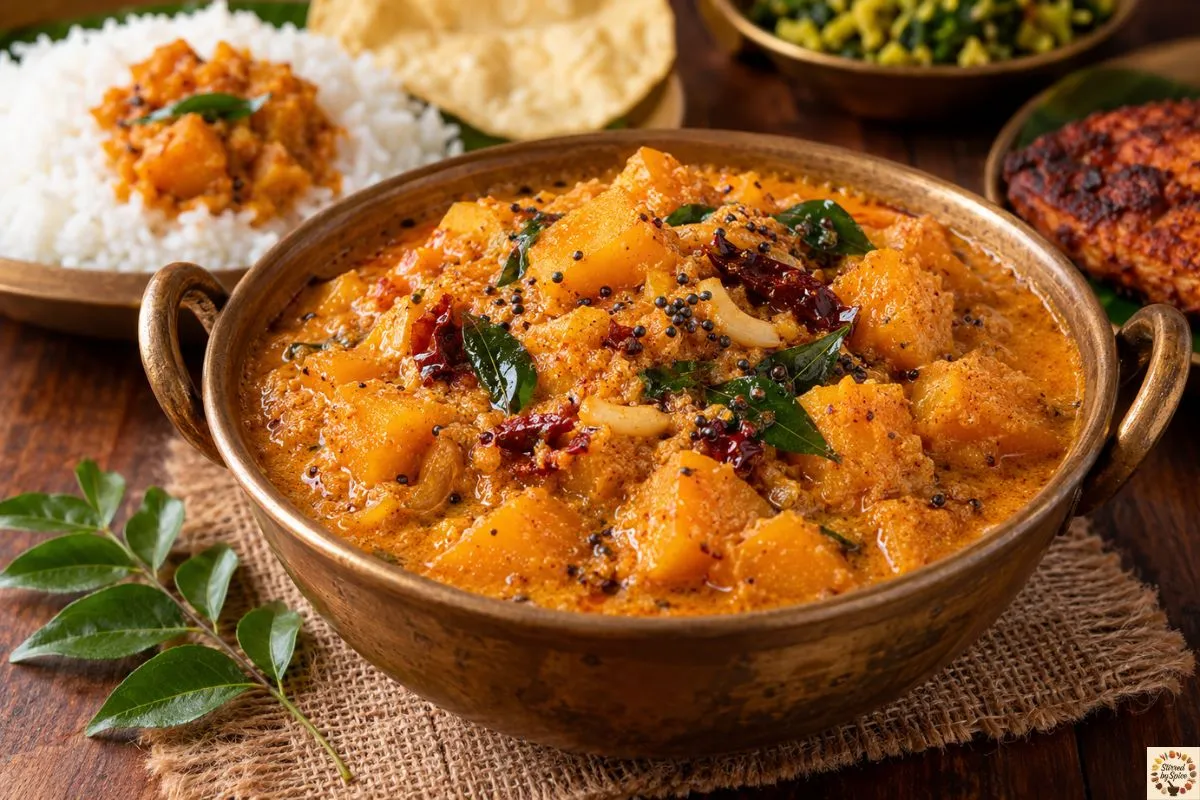
Photo by Stirred By Spice
📝 Ingredients
For the Pumpkin
2 cups pumpkin, peeled and cut into bite-sized cubes
2 medium tomatoes, cubed
1 tablespoon tamarind extract, diluted in 1 cup water
2 small pieces jaggery, each roughly the size of an index-finger segment, or to taste
Salt, to taste
For the roasted coconut-masala
1 tablespoon coconut oil
1 teaspoon urad dal
¼ teaspoon fenugreek seeds (methi)
½ tablespoon cumin seeds
2 tablespoons coriander seeds
½ tablespoon mustard seeds
5–6 Byadgi dried red chillies
3–4 garlic cloves, lightly crushed
A small sprig curry leaves
1 medium onion, sliced
1 cup grated coconut
½ teaspoon turmeric
For the tadka
Coconut oil, as needed
Mustard seeds
Curry leaves
Garlic cloves, lightly crushed
Dried red chilli, crushed
🍽️ Instructions
Step 1. Cook the pumpkin — Build the sweet-sour base.
Place the pumpkin, tomatoes, diluted tamarind extract, jaggery and salt in a kadai.Cook over medium heat for about 5–10 minutes, or until the pumpkin is tender but still
holds its shape. Switch off the heat and set aside.
Step 2. Begin the masala — Roast the urad dal and fenugreek.
Heat 1 tablespoon coconut oil in a separate pan. Add the urad dal and fenugreek seeds.Sauté gently until they begin to change color and become fragrant.
Step 3. Add the spices — Build the roasted flavor.
Add the cumin seeds, coriander seeds and mustard seeds. Roast gently, then add the curry leaves,crushed garlic and Byadgi chillies. Continue roasting until deeply aromatic, taking care not to burn
the spices. Transfer to a plate and set aside.
Step 4. Brown the onion and coconut — Develop the khoddel's depth.
In the same pan, add the sliced onion and sauté until golden. Add the grated coconut and continueroasting until the coconut turns light golden brown and fragrant.
Step 5. Grind the masala — Make a smooth paste.
Allow the roasted ingredients to cool slightly. Combine the roasted spices, onion-coconut mixtureand turmeric in a blender. Add just enough water to grind everything into a smooth paste.
Step 6. Bring the khoddel together — Let the flavors meet.
Add the ground masala to the cooked pumpkin and mix gently. Add a little water if needed to reacha thick, spoonable curry consistency. Bring to a gentle boil, allowing the pumpkin to absorb the
roasted masala, then switch off the heat.
Step 7. Make the tadka — Wake up the final aromas.
Heat a little coconut oil in a tadka pan. Add mustard seeds and allow them to splutter. Add curry leaves,lightly crushed garlic and crushed dried red chilli. Let everything sizzle until fragrant.
Step 8. Finish the khoddel — Pour, stir and serve.
Pour the hot tadka over the Pumpkin Khoddel. Stir gently and serve warm with steaming rice and papad,accompanied by a vegetable poriyal or fish fry.
🧡 Curious to know what tools I use in my everyday kitchen?
You can find my trusted cookware and appliances here → My Kitchen Resources
🍷 Optional Serving Notes
Traditionally, serve Pumpkin Khoddel with hot steamed rice, allowing the sweet, tangy,
roasted-coconut gravy to mingle generously with the rice.
Add a crisp papad for contrast, or serve it alongside a simple vegetable poriyal.
For a more traditional coastal meal, pair it with fish fry—the savory, crisp fish is wonderful
against the mellow sweetness of pumpkin, tamarind and jaggery.
And don't be shy with the gravy. This is the sort of curry that makes you reach for just a little more rice.
Cooking Indian food for the first time?
You don’t need everything at once.
If you’re new to Indian cooking and want to feel more confident, I’ve shared a FREE Spice Guide to help you
understand flavors without memorizing anything.
💬 Soulful Note
Some recipes are passed down on paper.
Others arrive through repetition—through watching hands, recognizing aromas,
tasting without measuring, and standing close enough to the stove
for knowledge to settle somewhere inside you.
I didn't realize, while watching my grandmothers cook, how much I was learning.
Years later, in my own American kitchen, I sometimes find my hands knowing what to do
before I have consciously remembered being taught.
Perhaps that is one of the quiet ways a kitchen keeps a family close.
The people we love may leave the room, but sometimes their hands remain in ours.
❤️
📚 Cook’s Wisdom / FAQs
👩🍳Cook's Wisdom:
My Dodda never cooked with measuring spoons. Ask her how much salt and she might
simply say, “Onji eethu kal uppu,” while showing you the amount with her fingers.
I cook much the same way today. The measurements here are for you; in my own kitchen,
I still cook largely by sight, aroma, taste and instinct.
Some kitchen knowledge is taught.
Some is inherited so quietly that one day you simply discover it living in your own hands.
💡 Helpful Tips
Choose a firm, sweet pumpkin.
Use pumpkin that will soften while cooking without immediately collapsing. The finished khoddelshould contain tender, recognizable pieces rather than becoming pumpkin purée.
Don't overcook the pumpkin in the first stage.
Cook it only until tender. It will heat again after the ground masala is added, so leaving the cubesintact at this stage helps preserve their texture.
Roast gently—the aroma is your guide.
The spices, garlic, onion and coconut develop much of the character of khoddel. Roast over moderateheat and allow their fragrance and color to develop without burning them.
Let the coconut become lightly golden.
Don't rush this step. That gentle browning gives the ground masala its deeper, nutty flavor.Balance sweet, sour and heat to your taste.
Pumpkins vary naturally in sweetness. Taste before serving and adjust the jaggery, tamarind or saltif needed. The finished khoddel should taste balanced rather than distinctly sweet.
Don't skip the final tadka.
The curry leaves, garlic, mustard and red chilli blooming in coconut oil add a fresh aromatic layerthat is quite different from the same ingredients ground into the masala.
❓ Frequently Asked Questions
What is khoddel?
Khoddel is a traditional Mangalorean preparation made with a roasted coconut-and-spice masalaand a balance of tangy, sweet and spicy flavors. Different seasonal ingredients can be used;
pumpkin and ripe mango are especially delicious versions.
Can I make this with ripe mango instead of pumpkin?
Yes. Ripe mango khoddel is a traditional variation and was my childhood favorite. The natural sweetnessand tartness of ripe mango pair beautifully with the roasted coconut, spices and tamarind.
What kind of pumpkin should I use?
Choose a flavorful pumpkin or winter squash with firm flesh that becomes tender without turning watery.Avoid very fibrous or exceptionally watery varieties.
Why are garlic and curry leaves used twice?
They serve different purposes. The first addition is roasted and ground into the coconut masala,creating depth throughout the curry. The second goes into the final tadka, giving the finished khoddel
a fresh burst of aroma and flavor.
Can I adjust the jaggery and tamarind?
Absolutely. Pumpkin, mango and jaggery all vary in sweetness, while tamarind varies in intensity.Use the recipe measurements as a starting point, then taste and adjust until the sweet, sour, salty
and spicy notes feel balanced.
What should I serve with Pumpkin Khoddel?
Serve it with hot rice and papad. A vegetable poriyal makes a lovely vegetarian accompaniment,while fish fry turns it into a particularly satisfying Mangalorean meal.
📊 Nutrition (Per Serving — Approx.)
Calories: ~260 kcal
Carbohydrates: ~29 g
Protein: ~5 g
Fat: ~15 g
Fiber: ~6 g
Sugar: ~12 g
Sodium: varies according to added salt
Nutrition is approximate and does not include rice, papad, fish fry or other accompaniments.
If You’d Like to Go Deeper..
Many of the dishes on this page are built on quiet spice knowledge —
the kind learned slowly, through observation, repetition, and care.
If you’d like a deeper understanding of Indian spices and everyday masalas —
how to choose them, use them, and build confidence over time —
you may enjoy the guide I’ve created alongside this kitchen.
🌼 From the Kitchen to the Story
This recipe brought me unexpectedly close to the meaning of Pitru Paksha—
a time of remembrance, gratitude and honoring those who came before us.
If the moment I shared here about my Dodda, memory and Presence spoke to you,
I wrote more about this beautiful tradition and what I have come to understand through it.
🌿 Read the story: Why We Offer Food First — Remembering Our Ancestors During Pitru Paksha →
🍃🌶🍃 The Bottom Line
Mangalorean Pumpkin Khoddel is what happens when a humble seasonal vegetable
meets the deep flavors of the coconut coast.
Sweet pumpkin, tart tamarind, jaggery, roasted coconut,
Byadgi chillies, garlic and warm spices come together in a curry
that is at once sweet, sour, spicy and deeply savory.
Serve it over steaming rice.
Add papad or a simple poriyal.
Bring fish fry to the table if you like.
But perhaps leave the measuring spoons in the drawer once in a while.
Taste. Smell. Watch. Adjust.
Because sometimes a recipe begins as instructions—
and, with enough years, ends up living in your hands.
❤️
💛 Meet the Heart Behind the Spice

Hi, I'm Maya. Welcome to my kitchen.
There's warmth in every story stirred into these recipes.
A Pediatric Dentist by profession and storyteller by soul,
I bring the rhythms of South Indian cooking
into my American kitchen—
a blend of tradition, curiosity, and heart.
Whether you're here for a comforting breakfast,
a festive feast, or a family favorite, I hope these recipes
help you slow down, cook with confidence,
and create memories around your own table.
Thank you for letting me be a small part of your kitchen.
🌿 Cook with joy.
Join the Table 🌿
If this felt a little like sitting around a familiar table, you’ll feel at home here.
I share simple South Indian meals, seasonal cooking, pantry wisdom and quiet kitchen rhythms —
straight from my stove to your inbox.
I’d love to have you at the table. 🌿
No spam. Just simple recipes and quiet kitchen stories.
💬 I’d Love to Hear From You!
Your words, memories, and reflections mean the world to me.
Share your thoughts using the form below — I read every message.
Affiliate Disclosure:
Some links on this page are affiliate links. As an Amazon Associate,
I earn from qualifying purchases —at no extra cost to you.
I only recommend tools I personally use and trust in my own kitchen.
© 2026 Stirred By Spice | Designed with warmth 🌶️ & stories.s 🪔 All rights reserved
Some images on this site are AI-generated to reflect the spirit of home cooking.