
🫘 Ulundu (Urad Dal)
The Little Dal That Runs Half the Indian Kitchen
🌿 Pantry Name: Urad Dal / Ulundu / Black Gram
🔬 Botanical Name: Vigna mungo
🫘 Ingredient Family: Pulse / Legume
🥣 Common Forms: Whole black, split with skin, split & dehusked
🫙 The South Indian Pantry
🌿 Introduction
Walk into an Indian grocery store for the first time and the dal aisle can feel like
someone has presented you with twenty bags of tiny beans
and forgotten to provide the map.
Yellow ones.
Green ones.
Red ones.
Black ones.
Split ones.
Whole ones.
And then there is Urad Dal.
Small.
Unassuming.
Sometimes black.
Sometimes creamy white.
Easy to overlook.
Which is rather funny, considering how much of the Indian kitchen would be inconvenienced
if it decided not to turn up for work.
Idli? Urad dal.
Dosa? Urad dal.
Medhu vadai? Definitely Urad dal.
It appears in papad and appalam,
tempering,
sweets,
snacks
and slow-cooked dals.
It can become soft, fluffy, crisp, creamy or wonderfully nutty
depending entirely on what the cook decides to do with it.
If an ingredient could have a CV, Ulundu would need two pages.
So let us take one of those mysterious bags off the grocery-store shelf
and properly introduce ourselves.
“The wisdom of a kitchen is not only knowing what an ingredient is—
but discovering everything it can become.”
🫘 Meet Ulundu — Beginner Confidence
Urad dal, also known as black gram, comes from the plant Vigna mungo,
a member of the legume family.
The whole seed wears a dark — almost black — outer skin
around a pale, creamy interior.
Remove the skin and suddenly our “black gram” becomes white.
Nothing mysterious has happened.
Same little bean. Different outfit.
Ulundu (Urad Dal)
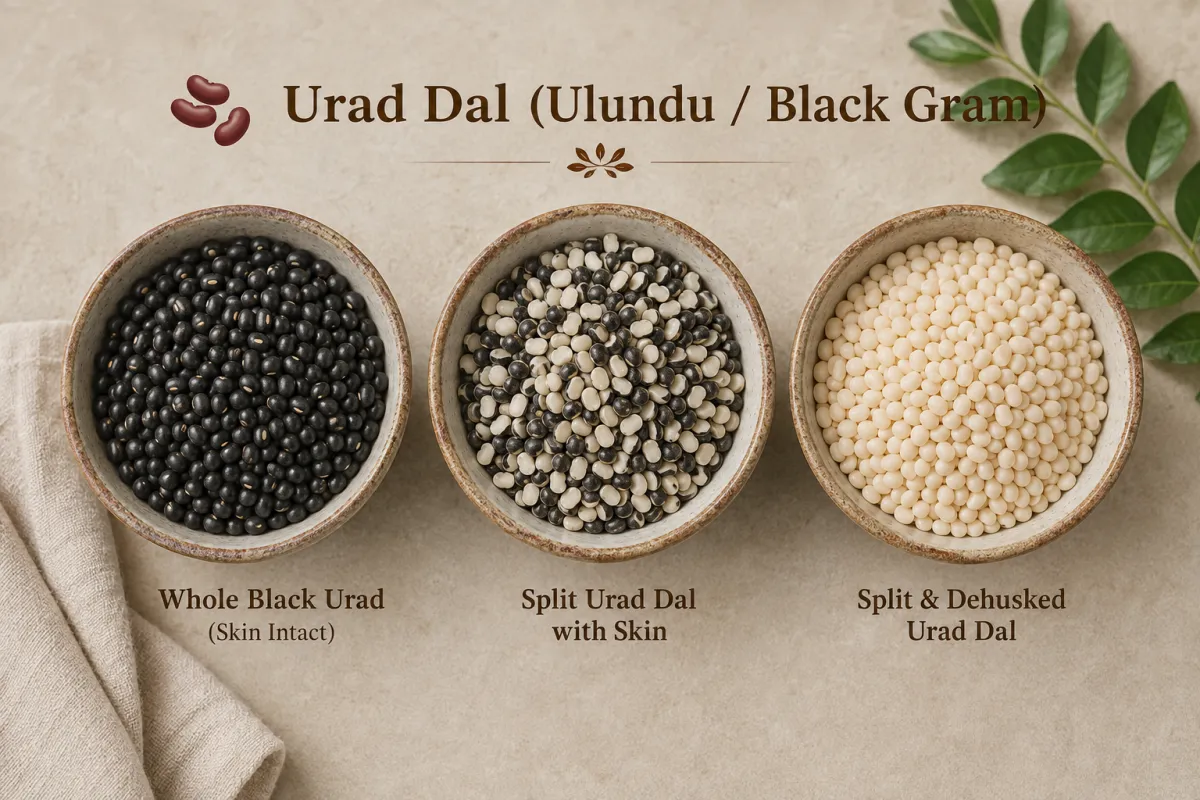
Photo by Stirred By Spice
What might I see at the store?
You will generally encounter Urad in a few forms:
Whole Urad / Whole Black Gram
The complete seed with its dark skin intact.
This is the form famously used in dishes such as dal makhani.
Split Urad with Skin
The grain has been split but retains its dark outer covering.
Split and Dehulled Urad Dal
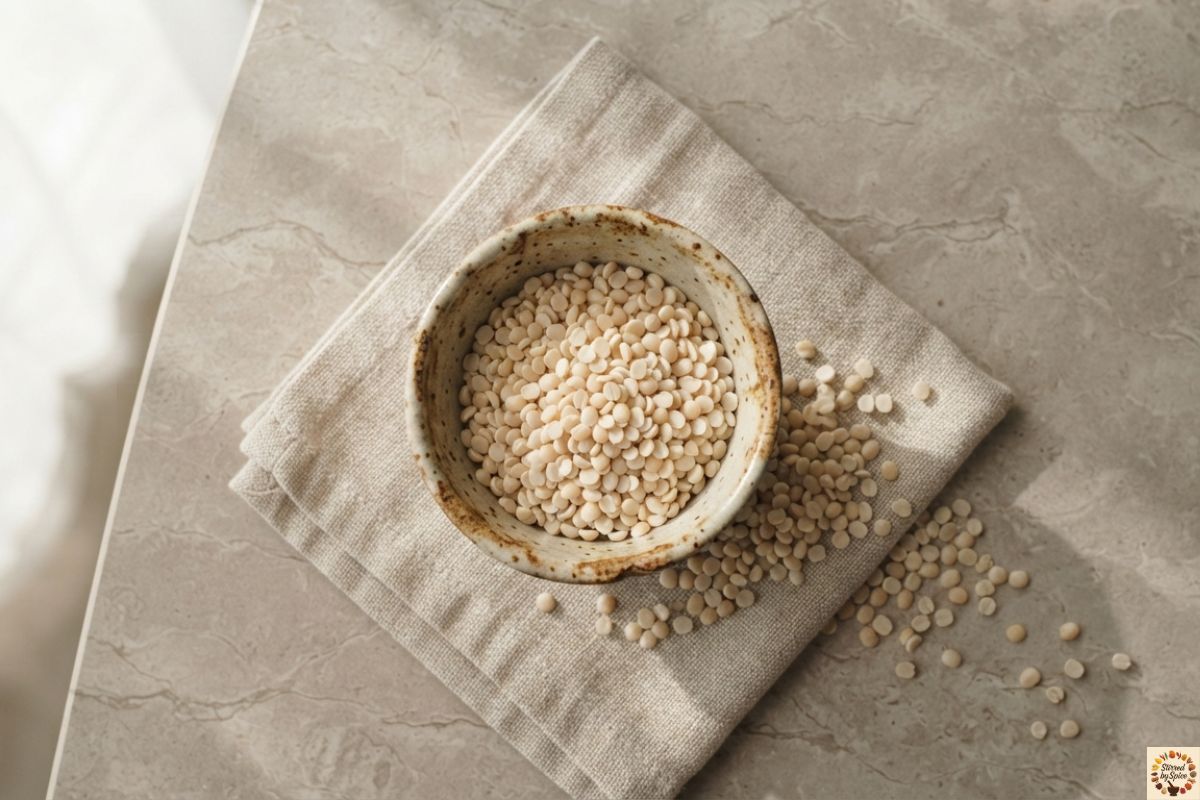
The dark skin has been removed, revealing the creamy-white interior.
This is the familiar form used extensively in South Indian cooking.
Depending on where you shop, the package may say
Urad Dal,
Black Gram,
Urad Gota,
Whole Urad
or another regional name.
One ingredient, many names
Travel through India and Ulundu changes names almost as often as it changes recipes.
In Tamil, you may hear ulundu or ulutham paruppu.
Kannada kitchens know it as uddina bele.
Malayalam uses uzhunnu.
Telugu kitchens know it as minapappu.
In Hindi, urad is widely used.
Different languages.
Same extraordinarily busy pulse.
Urad Dal
What does Urad Dal taste like?
On its own, Urad is relatively mild and earthy.
Roasting changes its personality beautifully, bringing out
a deeper, distinctly nutty aroma.
Slow cooking whole Urad produces a rich, creamy texture,
while grinding soaked dehulled Urad allows it to become
the foundation of some remarkably light batters.
And that brings us to what makes this ingredient truly interesting.
🌿 One Dal, Many Lives — Kitchen Wisdom
Urad Dal is fascinating not simply because it appears in many recipes.
It is fascinating because Indian cooks learned how to make the same ingredient
behave in dramatically different ways.
Change the water.
Change the grinding.
Change the fermentation.
Change the heat.
Change the cooking method.
And Ulundu changes right along with you.
Soak It — Let the Transformation Begin
Dried Urad absorbs water during soaking, softening the seed
and preparing it for grinding and cooking.
That simple bowl of dal sitting in water on the counter
is already beginning its transformation.
Aerate It — Hello, Medhu Vadai
A well-ground Urad batter can incorporate air, helping create
the characteristic light interior of medhu vadai.
Shape it into rings and lower it carefully into hot oil.
Outside: crisp.
Inside: soft.
And yes, even that famous hole is useful:
the ring shape exposes more of the batter to the hot oil
and helps a thick vadai cook more evenly.
Even the hole has a job.
Ferment It With Rice — Idli & Dosa Arrive
Combine ground Urad with rice in the traditional batters used for
idli and dosa and another transformation begins.
During fermentation, naturally occurring microorganisms alter the batter,
creating acidity, flavor and gases that contribute to its structure.
Your grandmother probably didn't describe any of this as microbial activity.
She said something much more useful:
“Keep it somewhere warm.”
The microorganisms apparently understood the assignment.
Steam It — Idli
Pour the fermented batter into moulds and steam it.
Now that fermented rice-and-Urad partnership becomes
something soft, tender and beautifully spongy.
Rice may receive plenty of attention,
but Urad is doing some
fairly serious structural engineering inside that idli.
Spread It — Dosa
Take a related fermented batter, spread it thinly across a hot tawa,
and the story changes again.
Water evaporates.
The surface cooks and browns.
Edges crisp.
And the same pulse that helped create a soft steamed idli
is now participating in a golden dosa.
One batter family.
Two entirely different personalities.
Roast It — The Tiny Crunch in Your Tempering
Sometimes Urad doesn't want the starring role at all.
A small spoonful of split Urad dropped into hot oil during a South Indian tempering
gradually turns golden, crisp and wonderfully nutty.
Add mustard seeds, curry leaves and perhaps a dried red chilli,
and that tiny amount of dal contributes texture and roasted flavor
to chutneys, poriyal, sundal, pachadi
and countless other dishes.
Here Ulundu isn't providing bulk.
It is providing the little golden bits everyone secretly hopes will land on their spoon.
Roast & Grind It — Idli Milagai Podi
Roasted Urad also finds its way into many versions of Idli Milagai Podi,
alongside ingredients such as dried chillies, other dals and sesame.
Roasting develops aroma and flavor while the dal contributes
body and texture to the finished podi.
Then comes one of South India's simplest equations:
Idli + Milagai Podi + Gingelly Oil.
At this point nobody is discussing food science.
They are eating the third idli.
And reaching for the fourth.
Slow-Cook It — Creaminess
Keep the dark skin intact, cook whole black Urad slowly,
and yet another personality emerges.
The pulse softens over prolonged cooking and contributes the characteristic
rich body associated with dishes
such as Dal Makhani.
No fermentation.
No tawa.
No steaming.
Same plant.
Completely different kitchen engineering.
Turn It Into Something Sweet
And just when you think you've understood Ulundu,
it wanders into the sweet counter.
Urad is used in traditional sweets
including Jangiri/Imarti and Sunnundalu,
where completely different techniques —
frying and soaking in syrup in one case,
roasting and combining with sweeteners and fat in another —
reveal yet more sides of the same ingredient.
Apparently Ulundu looked at the boundary between savoury and sweet
and decided it was merely a suggestion.
🔬 What's Happening Inside the Bowl?
This is perhaps the most interesting lesson Ulundu can teach us.
Ingredients are not static.
Cooking changes them.
Soaking changes hydration.
Grinding changes physical structure.
Aeration changes texture.
Fermentation changes acidity, aroma and batter behavior.
Roasting develops new aromas and flavors.
Frying rapidly removes surface moisture and creates crispness.
Slow cooking allows the pulse to soften and contribute body to a dish.
Indian cooks did not need to describe these transformations using modern food-science terminology
in order to observe them, repeat them and pass successful techniques
from one kitchen to another.
That is one of the things I find most beautiful about traditional cooking.
Technique became knowledge long before someone gave the process
a scientific vocabulary.
📜 An Ingredient With a Long Memory
Ulundu's place in the Indian kitchen is not a recent one.
Known in Sanskrit as māṣa, black gram appears in India's long food and
agricultural history and is also discussed within
classical Ayurvedic food traditions.
Those traditions developed their own vocabulary
for describing foods and their perceived qualities —
a framework belonging to Ayurveda
rather than modern nutritional science.
Today, food science gives us another way of examining the same ingredient:
its protein and carbohydrate content,
physical behavior during soaking and grinding,
and the microbial transformations involved in fermentation.
The two traditions do not need to be made identical in order for both to be interesting.
One tells us something about how earlier Indian food cultures
understood and used an ingredient.
The other helps us investigate what is happening
physically, chemically and biologically inside the bowl.
And the kitchen?
The kitchen simply keeps cooking.
🥣 What Does Urad Dal Bring to the Plate?
Like other pulses, dry black gram is naturally rich in plant protein
and also provides
carbohydrates, fibre and a range of micronutrients.
But perhaps the more useful lesson is not to reduce Ulundu to a single number.
Food rarely arrives as one isolated nutrient.
And Urad Dal certainly didn't spend several thousand years in Indian kitchens
waiting to be discovered by the protein-marketing department.
It was already there.
In breakfast.
In tiffin.
In tempering.
In festive foods.
In everyday meals.
Quietly doing its work.
🍲 Put the Wisdom on the Plate
Now that you've met Ulundu, the best way to understand it is to cook with it.
Try Urad Dal in the Stirred By Spice Kitchen
Crispy Plain Dosa
Watch rice and Urad fermentation become a crisp South Indian classic.
Masala Dosa
Take that dosa one delicious step further.
Adai
See Urad join other dals in a hearty mixed-pulse pancake.
Idli and other Ulundu recipes
As our kitchen grows, you'll find more ways to cook with this wonderfully
versatile ingredient here.
🌿 Continue Exploring
Wondering what pulses like Urad contribute nutritionally —
and why plant protein doesn't need
quite so much drama?
🍃🌶🍃 The Bottom Line
Perhaps the genius of Urad Dal isn't simply that Indian cuisine found many recipes for it.
It is that generations of cooks learned to understand its behavior.
They soaked it.
Ground it.
Aerated it.
Fermented it.
Steamed it.
Spread it.
Roasted it.
Fried it.
Slow-cooked it.
Sweetened it.
And each technique revealed something different.
That is kitchen wisdom.
Not merely knowing what an ingredient is, but learning what it can become.
So the next time you stand in an Indian grocery aisle looking at a little bag marked URAD DAL,
you won't have to wonder what on earth you're supposed to do with it.
You'll know the fellow.
Small.
Black and white.
Rather unassuming.
And apparently responsible for an unreasonable percentage of breakfast.
Long live Ulundu —
the little dal with absolutely no intention of retiring. 🫘❤️
🧺 Explore the SBS Pantry
One ingredient at a time, we're opening the jars of the South Indian kitchen —
learning what they are,
how they're used,
and the quiet wisdom they carry.
🫘 Ulundu (Urad Dal) — The little dal that runs half the Indian kitchen
🫘 [Your second dal] — coming/linked once ready
💛 Meet the Heart Behind the Spice

Hi, I'm Maya. Welcome to my kitchen.
There's warmth in every story stirred into these recipes.
A Pediatric Dentist by profession and storyteller by soul,
I bring the rhythms of South Indian cooking
into my American kitchen—
a blend of tradition, curiosity, and heart.
Whether you're here for a comforting breakfast,
a festive feast, or a family favorite, I hope these recipes
help you slow down, cook with confidence,
and create memories around your own table.
Thank you for letting me be a small part of your kitchen.
🌿 Cook with joy.
Join the Table 🌿
If this felt a little like sitting around a familiar table, you’ll feel at home here.
I share simple South Indian meals, seasonal cooking, pantry wisdom and quiet kitchen rhythms —
straight from my stove to your inbox.
I’d love to have you at the table. 🌿
No spam. Just simple recipes and quiet kitchen stories.
💬 I’d Love to Hear From You!
Your words, memories, and reflections mean the world to me.
Share your thoughts using the form below — I read every message.
Affiliate Disclosure:
Some links on this page are affiliate links. As an Amazon Associate,
I earn from qualifying purchases —at no extra cost to you.
I only recommend tools I personally use and trust in my own kitchen.
© 2026 Stirred By Spice | Designed with warmth 🌶️ & stories.s 🪔 All rights reserved
Some images on this site are AI-generated to reflect the spirit of home cooking.