
🐘❤️ The Form Leaves.
The Relationship Does Not.
Ganesh Chaturthi, Visarjan, and What It Means to Welcome Ganesha Home
❤️ Stories of Devotion
Some of my earliest memories of Ganesh Chaturthi begin outside the front door.
Early in the morning in Tamil Nadu, before the day had properly begun,
the courtyards outside the homes in our neighborhood would be freshly cleaned
and sprinkled with cow-dung water, leaving the ground damp and green
beneath the first light of the sun.
Then came the kolams.
Beautiful white patterns appeared across the courtyards, drawn by the women of the homes.
And sitting cheerfully in the centre of some of them would be
a little Pillaiyar shaped from golden turmeric,
with a bright red hibiscus pinned to His head.
I loved seeing Him there.
The early morning sun would catch the yellow turmeric and make the hibiscus glow
against the green courtyard and white kolam.
At the time, I wasn't thinking about symbolism or ritual.
I was simply a child delighted to find Pillaiyar waiting outside.
These were not rituals my own mother practised at home.
She had grown up in Mangalore and held closely to many of the traditions she had brought with her.
I learned the Tamil expressions of Ganesh Chaturthi largely by watching the homes around me.
But inside our house, another kind of remembering was happening.
It was happening in the kitchen.
“We make space. We cook. We decorate. We offer.
And somewhere in those ordinary acts of care,
the Divine begins to feel at home.”Perhaps that is what it means to welcome Ganesha.
🐘❤️
🌺 Pillaiyar in the Morning Light
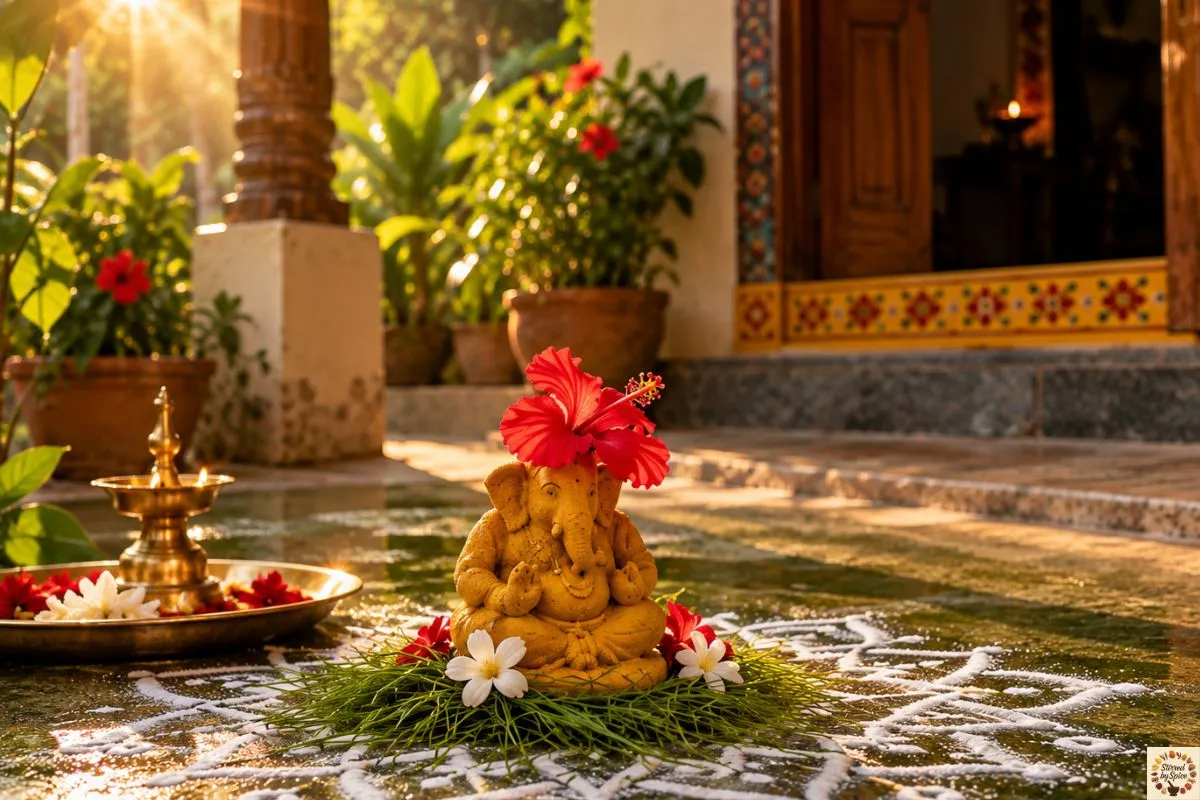
Photo by Stirred By Spice
Outside the House, I Learned by Watching.
Inside, I Learned by Eating.
My mother loved to cook, and no festival passed through our home
without announcing itself through food.
Ganesh Chaturthi meant kozhukattai—sweet ones and savoury ones, different shapes and fillings,
rice flour and coconut and jaggery passing through her hands.
There was sundal too.
And alongside the Tamil festival foods came something unmistakably Mangalorean: Manjal Iretha Gatti,
made with rice, coconut and jaggery and cooked in fragrant turmeric leaves.
I didn't have language for it then, but I can see it now.
Outside our home, I was absorbing the culture of the place in which I was growing up.
Inside it, my mother was preserving the culture of the place from which she had come.
And food somehow made room for both.
Perhaps that is one of the quiet gifts of growing up between cultures.
We don't always inherit tradition in tidy, separate boxes.
One memory borrows the fragrance of another.
A Tamil courtyard leads into a Mangalorean kitchen.
The language changes.
The recipes change.
And Pillaiyar sits happily in the middle of all of it.
🐘❤️
🪔 From This Ganesha Kitchen
Two offerings for Ganesh Chaturthi, from my kitchen to yours.
🥥✨ Kozhukattai
(Sweet & Savory Variants)
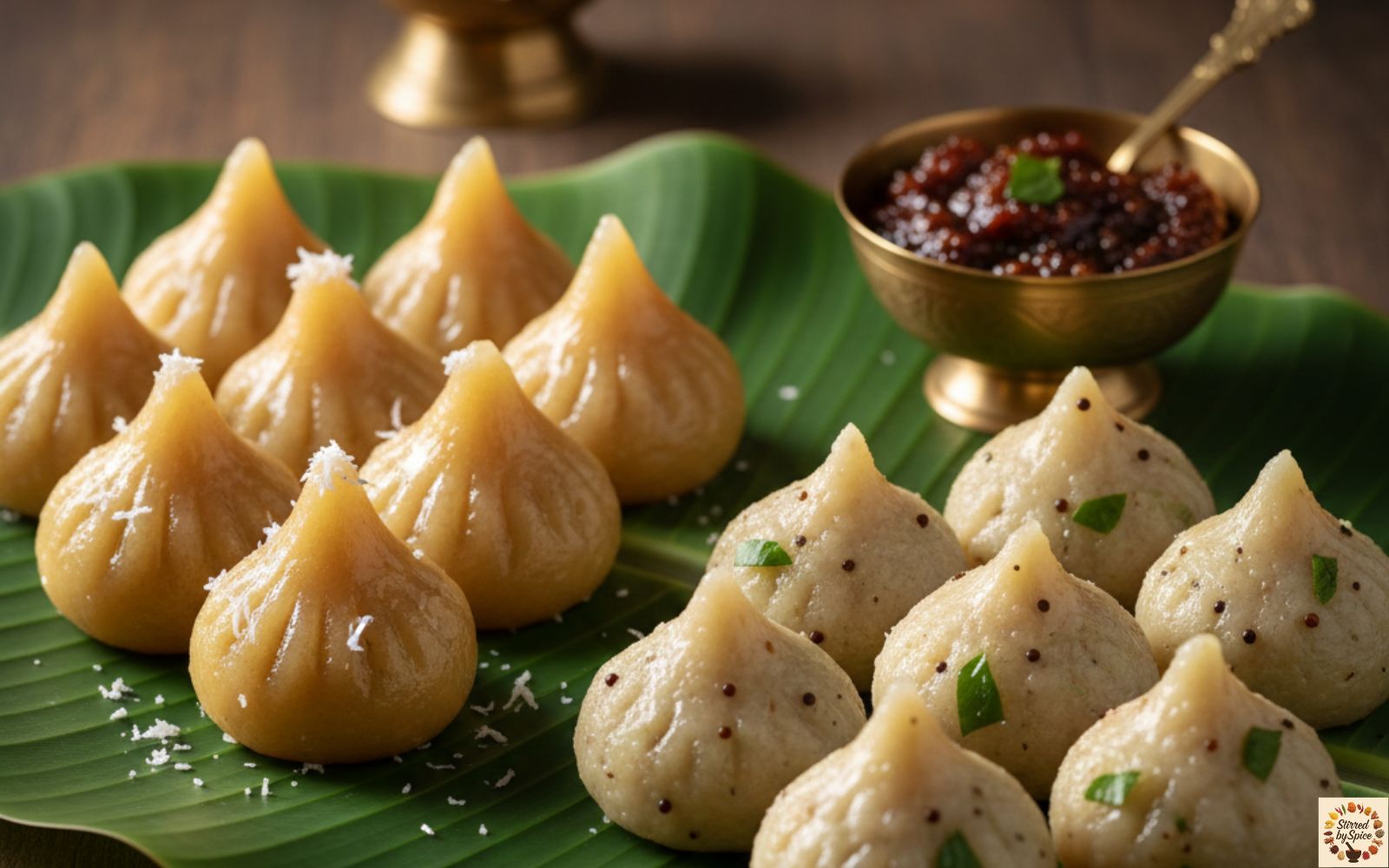
Soft rice dumplings filled with
sweet or savory coconut —
a tender, fragrant festive classic.
🧆 Sundal
(ChickPea Stir Fry)
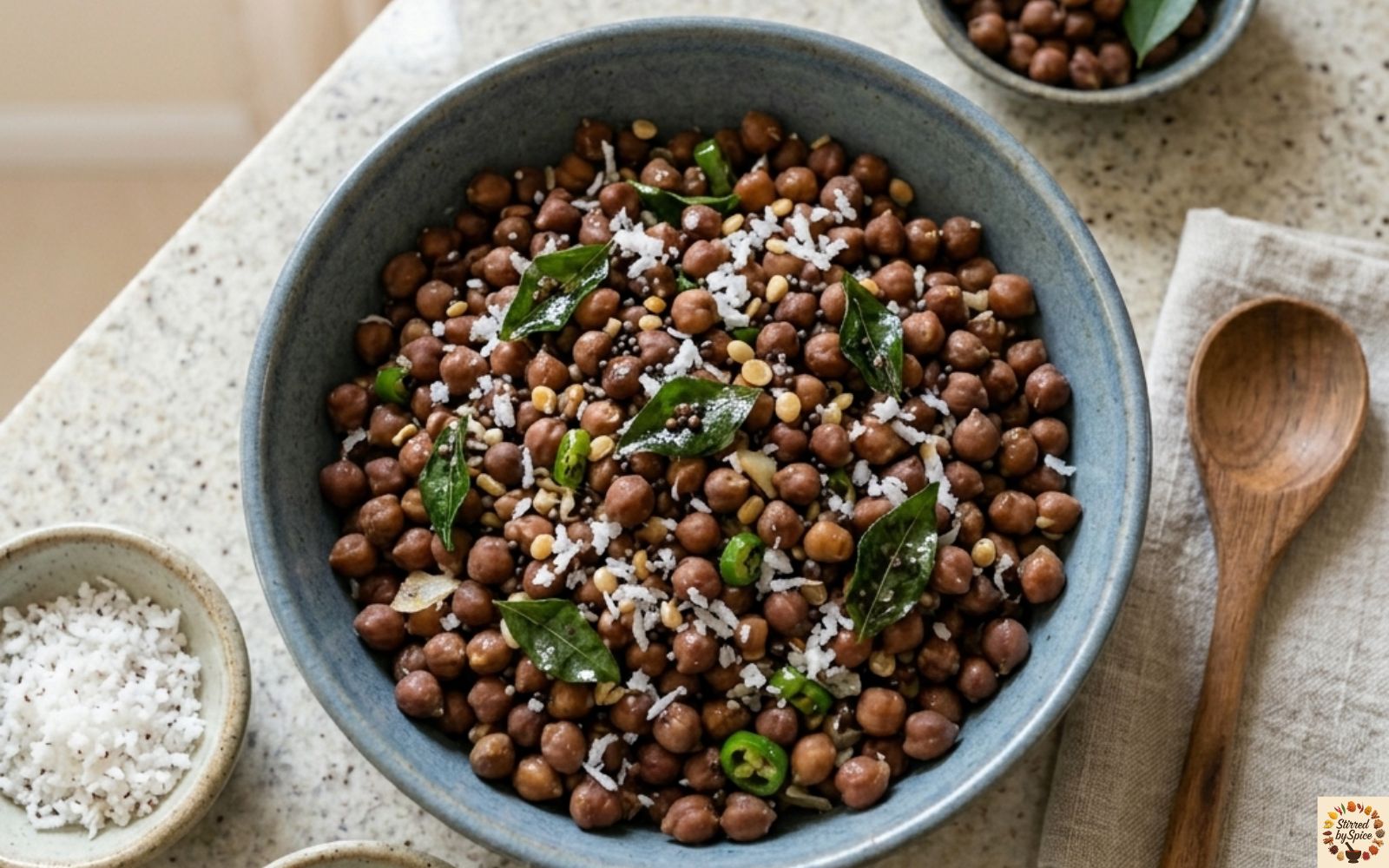
A temple-inspired South Indian chickpea
stir-fry filled with simple spices,
coconut, and comforting tradition.
Not every kitchen will prepare the same dishes.
It doesn't need to.
There are many ways to set a place for someone beloved.
When Pillaiyar Became Mine
As I grew older, my relationship with Ganesha became my own.
He is my Ishta Devata—the form of the Divine to whom my heart
has always felt especially drawn.
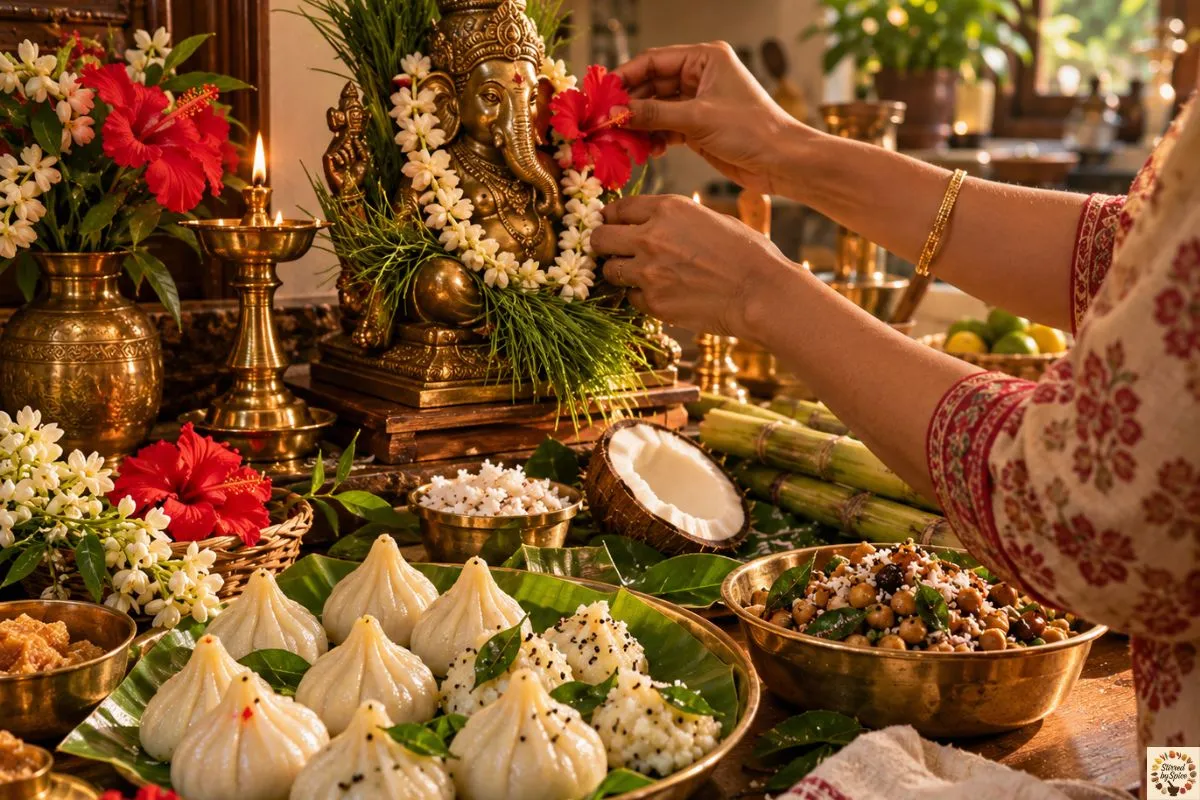
When I had my own home, I began celebrating Him in ways that had delighted me growing up.
I dressed Him in little skirts made from fresh arugampul.
I garlanded Him with flowers.
Sugarcane and coconuts appeared among His offerings.
There was something wonderfully tender about it.
We speak of worship as though it belongs only to temples and prayer books,
but so much of devotion is expressed through ordinary acts of care.
We clean a place for God.
We decorate it.
We gather flowers.
We cook.
We offer food before eating it ourselves.
We fuss over whether everything looks beautiful.
For a little while, the Divine becomes part of the rhythm of the household.
And perhaps that is why Ganesh Chaturthi has always felt less to me
like observing a festival from a distance
and more like welcoming someone beloved home.
🐘
And Then I Met Another Ganesha
Years later, when I was studying dentistry in Mangalore,
Ganesh Chaturthi looked different again.
This time Ganesha arrived not as the little turmeric Pillaiyar
I remembered from neighboring courtyards,
but as a large murti brought onto our college campus.
We students helped decorate Him with flowers and rangoli.
For the days He remained with us, the celebration belonged not to one household
but to a community.
And then came the final day.
There was prasadam for everyone who had gathered.
There was music.
There was dancing.
There was the excitement and noise of a procession
as Ganesha was placed onto a truck and accompanied away
by the male students toward the sea for Visarjan.
I didn't travel with them to the immersion site.
My memory ends with His departure from campus.
Perhaps that is why, looking back now, the image that stays with me
is not Ganesha disappearing into the water.
It is Ganesha leaving.
As a young student, I don't remember asking myself what that departure meant.
It was simply part of the celebration I was experiencing.
The question came much later.
Why do we welcome Ganesha so lovingly, only to let Him go?
🐘
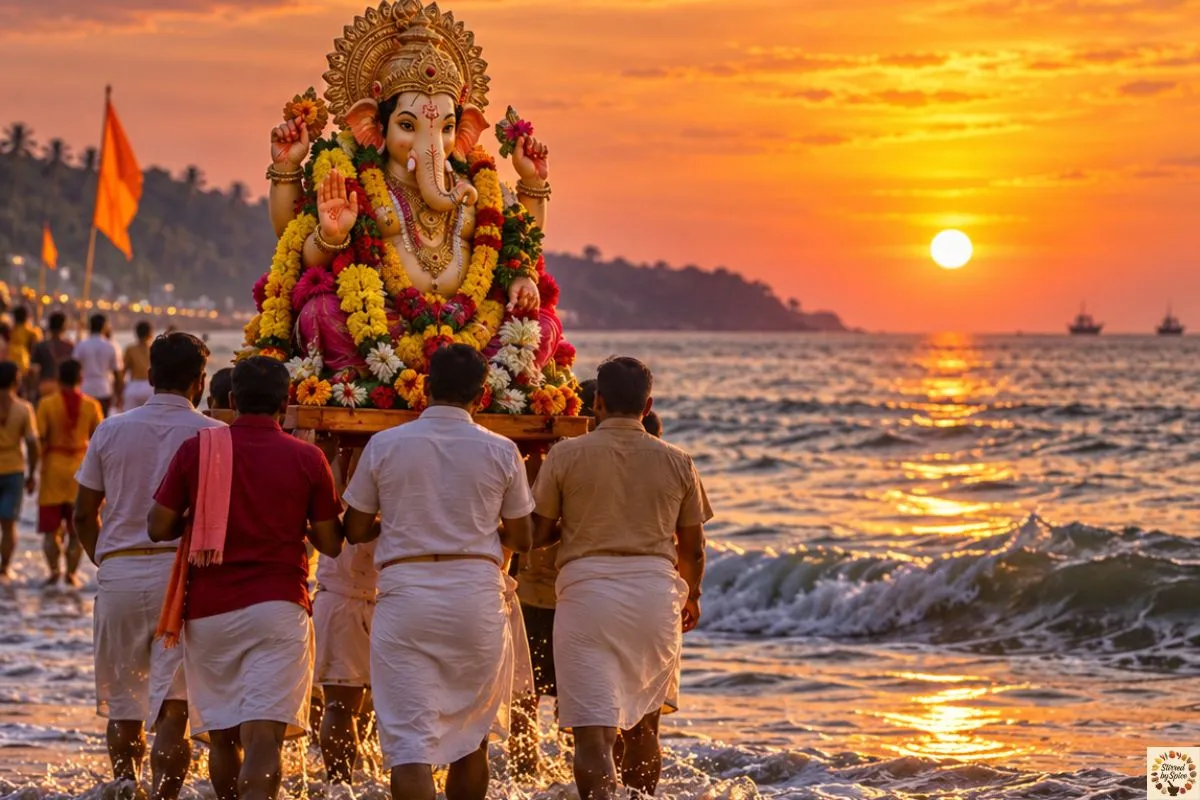
From Welcome to Release
Ganesh Chaturthi contains an extraordinary movement.
First, we invite.
A murti is brought home or installed within a community.
Ganesha is welcomed and worshipped.
Flowers are offered.
Lamps are lit.
Mantras and prayers are recited.
Food is prepared and placed before Him.
For several days, we practise presence.
And then comes Visarjan.
The very form we welcomed, decorated, fed and gathered around must be released.
Traditionally, the clay murti is carried to water and immersed.
At first glance, it can feel almost contradictory.
Why spend so much time making a sacred form beautiful
if we already know that we are going to let it go?
There are ritual and philosophical traditions much older and deeper
than any single explanation I could offer.
But as I have grown older, Visarjan has begun to ask something of me personally.
Perhaps the form was never meant to contain the relationship.
We human beings need form.
We need somewhere for our eyes to rest and our hands to serve.
We need names to call.
We need flowers to offer.
We need food to place before someone we cannot otherwise feed.
We need a little turmeric Pillaiyar sitting in a kolam.
We need a murti covered in flowers on a college campus.
We need something our hands can decorate while our hearts learn what devotion feels like.
And then, perhaps, Visarjan gently asks us not to mistake the form
for the entirety of what it helped us encounter.
The clay returns to water.
But where does the relationship go?
🐘
The Form Leaves. The Relationship Does Not.
I think now about that little girl stepping outside on a Ganesh Chaturthi
morning in Tamil Nadu.
She didn't know the words āvāhana, upāsanā or visarjana.
She didn't know that years later she would study in Mangalore
and watch another Ganesha depart
in procession toward the sea.
She certainly didn't know that one day she would live
thousands of miles away from both those places.
She only knew that the courtyard was green and damp.
That the kolam was beautiful.
That the first sunlight made the turmeric glow.
And that somebody had placed a bright hibiscus on Pillaiyar's head.
She loved Him.
Perhaps that was enough.
Because decades later, she would still gather arugampul for Him.
She would still bring flowers.
She would still offer coconuts and sugarcane.
She would still make kozhukattai.
The courtyards changed.
The kitchens changed.
Countries changed.
The forms through which I encountered Him changed too.
But somehow, Pillaiyar stayed.
And perhaps that is the lesson Visarjan has slowly come to hold for me.
There are things we love whose physical forms cannot remain forever.
There are places we leave,
rituals that change,
people whose hands no longer prepare the foods we remember,
homes we can no longer walk back into exactly as they were.
We cannot preserve everything by holding onto its form.
Sometimes what remains is something quieter.
A fragrance.
A recipe.
A prayer.
A gesture our hands somehow remember.
A little golden Pillaiyar in the morning sun.
The form leaves.
The relationship does not.
And when Ganesh Chaturthi comes again, we begin where we always have.
We make space.
We cook.
We decorate.
We call Him home.
Ganapati Bappa Morya.
🐘🙏❤️
🌺 A Quiet Reflection
Perhaps devotion does not always begin with understanding.
Sometimes it begins much smaller—
with a flower placed carefully before a deity,
a sweet prepared because someone before us always prepared it,
a prayer whose words we learned long before we understood them,
or simply the certainty, held by a child, that this God is beloved.
We may carry these gestures for years before understanding what they have been carrying for us.
And perhaps that is one of the quiet gifts of tradition.
Meaning does not always arrive first.
Sometimes love does.
Understanding catches up later.
❤️
🐘 Walk a Little Further
Is there a tradition from your childhood that means something different to you now than it did then?
Perhaps it is a festival you once loved simply for the excitement,
a prayer whose words you learned before you understood them,
a dish someone always prepared,
a song that lived quietly in the background of childhood,
or a small ritual you followed simply because everyone else did.
Years later, we sometimes discover that these ordinary things were carrying more than we knew.
A memory becomes meaning.
A habit becomes inheritance.
And something we once simply did becomes something we consciously choose to carry forward.
What tradition have you grown into?
❤️
❤️ A Few More Stories to Savor

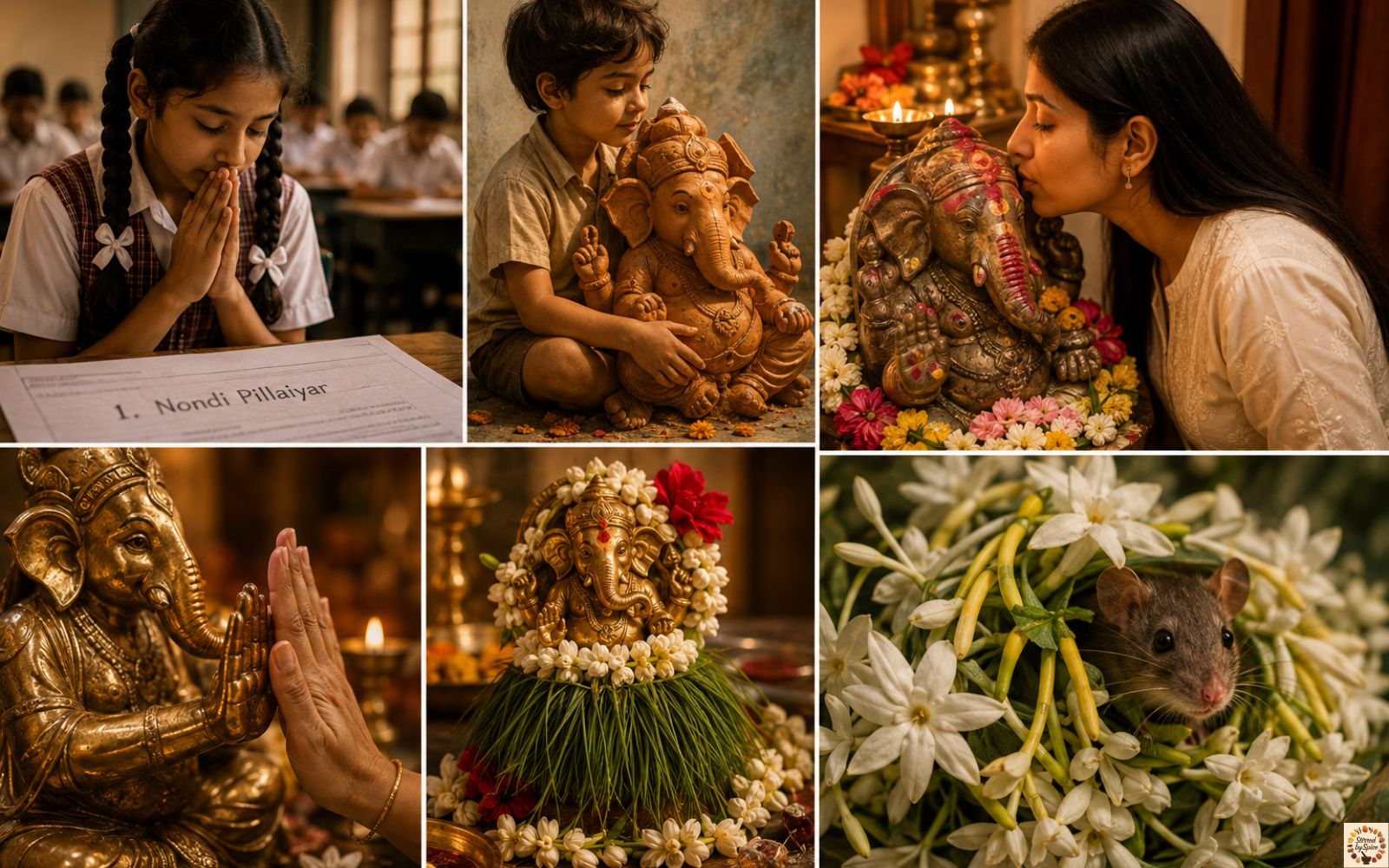
🙏 Temple & Prasadam Collection
Every sweet in this collection carries more than tradition.
It carries the quiet joy of offering simple food with gratitude,
whether to the Divine, to our families,
or to the memories
that continue to nourish us
long after the meal is over.
🪔 Part of Temple Prasadam Collection
A growing library of sacred offerings prepared for Hindu temples, festivals,
and home worship throughout the year.
🌼 Krishna Janmashtami Collection
🐘 Ganesh Chaturthi Collection
🪔 Navaratri Collection
🔥 Deepavali Collection
🌾 Pongal Collection
🌺 Varalakshmi Vratham Collection
🌿 Ugadi Collection
💛 Meet the Heart Behind the Spice

Hi, I'm Maya. Welcome to my kitchen.
There's warmth in every story stirred into these recipes.
A Pediatric Dentist by profession and storyteller by soul,
I bring the rhythms of South Indian cooking
into my American kitchen—
a blend of tradition, curiosity, and heart.
Whether you're here for a comforting breakfast,
a festive feast, or a family favorite, I hope these recipes
help you slow down, cook with confidence,
and create memories around your own table.
Thank you for letting me be a small part of your kitchen.
🌿 Cook with joy.
Join the Table 🌿
If this felt a little like sitting around a familiar table, you’ll feel at home here.
I share simple South Indian meals, seasonal cooking, pantry wisdom and quiet kitchen rhythms —
straight from my stove to your inbox.
I’d love to have you at the table. 🌿
No spam. Just simple recipes and quiet kitchen stories.
💬 I’d Love to Hear From You!
If this story brought back a tradition, memory, or small ritual from your own life,
I'd be honored to hear about it.
Your words, memories, and reflections mean the world to me.
Share your thoughts using the form below — I read every message.
Affiliate Disclosure:
Some links on this page are affiliate links. As an Amazon Associate,
I earn from qualifying purchases —at no extra cost to you.
I only recommend tools I personally use and trust in my own kitchen.
© 2026 Stirred By Spice | Designed with warmth 🌶️ & stories.s 🪔 All rights reserved
Some images on this site are AI-generated to reflect the spirit of home cooking.