
❤️ When She Made the Circle Wider
A Ganesh Chaturthi Story About Belonging
❤️ Stories of Devotion
When She Made the Circle Wider
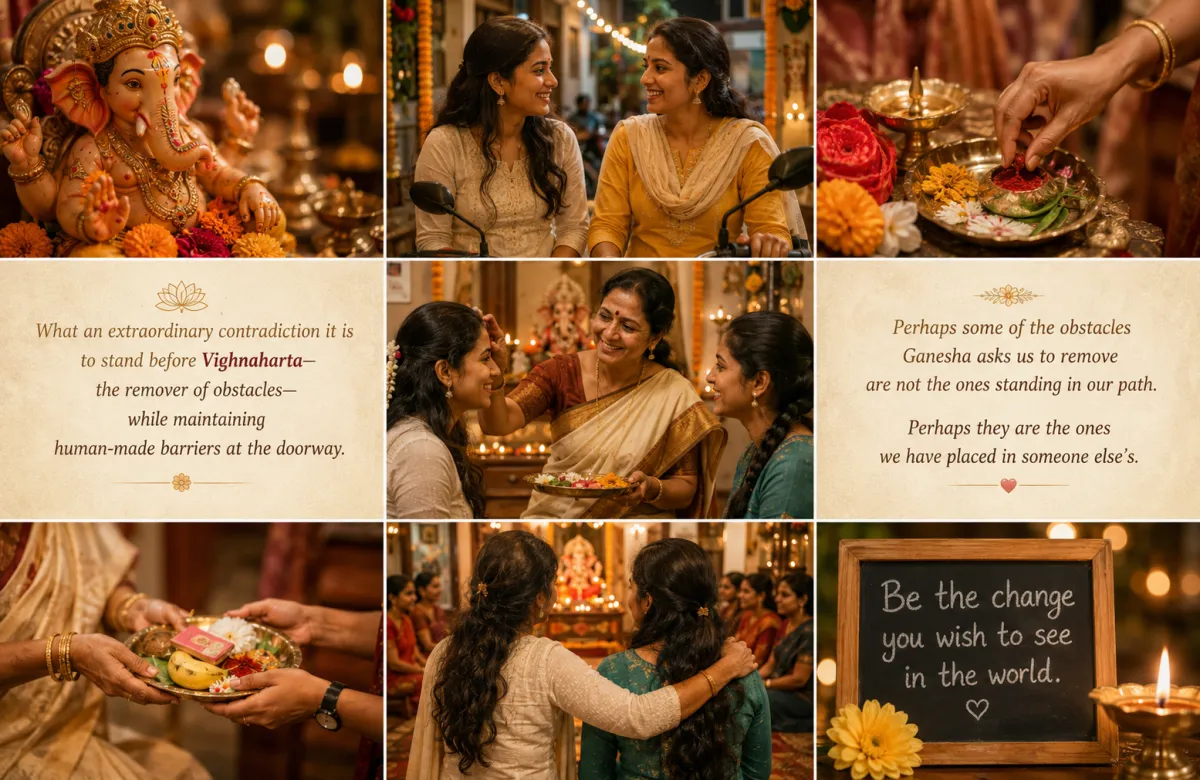
Photo by Stirred By Spice
Sometimes change does not arrive with an argument.
Sometimes it looks like a woman holding a plate of kumkum who simply
refuses to leave anyone outside the circle.
In India, Ganesh Chaturthi arrives with a particular kind of joy.
Homes fill with flowers and food.
Families gather.
Music spills into streets and neighborhoods.
Ganesha is welcomed with lamps, prayers and sweets,
and voices rise together in the familiar chant:
Ganapati Bappa Morya!
It was during one such festive season that a friend said
something to me as we were leaving work.
“My mother is celebrating Ganesh Chaturthi at home.
I want you to come home with us for the celebration.”
I looked at her.
“Me? Are you sure?”
She knew exactly why I was asking.
My friend was widowed. I was divorced.
We had shared enough of our lives with each other to understand
the things that sometimes did not need to be said aloud.
In some families and communities, women whose marital circumstances have changed
can find themselves treated differently during occasions considered auspicious.
Sometimes the exclusion is obvious.
Sometimes it is disguised as custom.
Sometimes nobody says anything at all—
the woman simply learns, from a hundred small gestures,
where she is expected to stand.
My friend knew my hesitation because she knew something of that world too.
She took my hand.
“Yes. YOU. Let's go. I want you to come with me.”
So I climbed onto her bike, and off we went.
🐘
A House Full of Celebration
Her mother's home was crowded when we arrived.
The festive air was everywhere—family, conversation, food, flowers,
the happy commotion that accompanies a house filled with people.
Her family had gathered for the celebration, many of them with their spouses and children.
As I looked around the room, I found myself glancing at her.
I knew some of what she carried in her heart, and I wondered
what it felt like for her to stand among all those families
while carrying a grief most people in the room could not see.
Yet there she was beside me.
Smiling.
And because she was there, I stayed.
The puja began.
Soon the room filled with voices.
Ganapati Bappa Morya!
I joined them.
But some part of me still wanted to disappear quietly into the wall.
I had learned to be cautious in rooms like this.
There was a reason.
🐘
A Sentence I Had Not Forgotten
Not long before, my youngest cousin had been married.
We cousins had grown up together, and on her wedding day I had dressed for the celebration
and joined the others walking behind the bride toward the wedding hall.
I remember the happiness of that moment.
And then I felt someone tug at my elbow.
I turned.
It was my mother.
She pulled me aside and asked what I was doing among the wedding party.
I should not be participating like this, she told me.
I was divorced.
My presence in an auspicious gathering could be considered apashakuna—inauspicious.
I froze.
It felt as though someone had thrown a bucket of cold water over me.
I don't remember much of what happened immediately afterward.
I only remember that I could no longer hear the celebration in quite the same way.
Something in me withdrew.
And after that, whenever I encountered occasions surrounded by rules
about what was auspicious and who was permitted to participate fully,
I learned to step back before somebody could ask me to.
So when my friend had said,
“I want you to come,”
my first response had been:
Me? Are you sure?
🐘
When Her Mother Reached Us
After the Ganesh puja ended, my friend's mother began moving
among the women who had gathered.
She carried the traditional offerings associated with the occasion—kumkum, turmeric,
flowers, betel leaves and nuts, fruit and coconut.
Tamboolam.
I watched her move from one woman to another.
Flowers were placed in their hair.
Kumkum touched their foreheads.
Plates of auspicious offerings were placed in their hands.
Eventually, she reached us.
I don't know what I expected.
Perhaps I had already prepared myself for that tiny hesitation I had learned to recognize.
A pause.
A different gesture.
Some subtle indication that we belonged to another category.
Instead, she reached for a flower garland.
She placed it in her daughter's hair.
Then she turned to me.
And placed one in mine.
She put kumkum on my friend's forehead.
Then on mine.
She handed her tamboolam.
Then she handed the same to me—turmeric, flowers, betel nuts, fruit and coconut.
Exactly as she had done for everyone else.
She didn't hesitate.
She didn't explain.
She didn't blink.
There was no special category for us.
No pity.
No qualification attached to our belonging.
Then she fed us sweets with her own hands and insisted that we take some home.
And suddenly I was crying.
We Didn't Need to Say Anything
My friend looked at me.
She had tears in her eyes too.
She squeezed my hand.
I squeezed hers.
Neither of us said anything.
We didn't need to.
Two women who knew what it felt like to be regarded differently were standing beside each other
experiencing something that should never have been extraordinary:
We were being treated exactly like everybody else.
I don't know whether her mother understood what her simple gestures had meant to us that day.
Perhaps she went to bed that night remembering nothing unusual at all.
But I remembered.
I still do.
Because without knowing it, she had placed kumkum on the exact place
where another woman's words had once wounded me.
One woman had made me feel that my presence diminished an auspicious occasion.
Another woman welcomed me into one without hesitation.
She did not restore my dignity—because my dignity had never been lost.
But she restored something else.
My sense that I could belong without qualification.
🐘
The Woman Who Made the Circle Wider
Over the years, I have thought often about that woman.
What stays with me is not that she made some grand statement against tradition.
She didn't.
She simply behaved according to the kindness in her own heart.
She did not need to experience divorce herself before treating a divorced woman with dignity.
She did not need to experience widowhood before recognizing the dignity of a widow.
She did not need suffering to teach her empathy.
Her heart was already large enough.
Sometimes we speak about changing society as though change must begin with
movements, declarations and enormous acts of courage.
Sometimes it does.
But sometimes reform begins much more quietly.
One person notices who has been pushed toward the edge—
and makes the circle wider.
No announcement.
No applause.
Just:
Come. There is room for you here.
🐘
What Happens After We Leave the Altar?
There is something I have come to think about whenever Ganesh Chaturthi returns.
We worship Ganesha as Vighnaharta—the remover of obstacles.
We ask Him to clear our paths.
We pray for wisdom.
We ask for grace.
We invite Him lovingly into our homes.
And yet, what an extraordinary contradiction it is to stand before Vighnaharta—
the remover of obstacles— while maintaining human-made barriers at the doorway.
Perhaps some of the obstacles Ganesha asks us to remove are not the ones standing in our path.
Perhaps they are the ones we have placed in someone else's.
An inherited belief.
An unquestioned custom.
A distinction between who is considered auspicious and who is not.
The assumption that a woman's marital status somehow determines the
joy, dignity or sacredness she is permitted to carry into a room.
Tradition can hold extraordinary beauty.
But surely devotion must also ask something of us
after the lamp has been extinguished
and the puja plate put away.
How do we treat the person standing beside us?
Who have we quietly pushed toward the edge?
Whose absence have we stopped noticing?
Whom have we made afraid to enter our homes?
And when we recognize it, are we willing to make room?
🐘
The Promise I Made to Myself
Something changed for me after that Ganesh Chaturthi.
I decided that I would celebrate the festival with joy from then onward,
regardless of whether life described me as single or married.
Ganesh Chaturthi belonged to me too.
And I kept that promise.
Every year when the festival returns, I remember the woman who welcomed
two women into her celebration
and never once made them feel that she was doing them a favor.
I remember flowers in my hair.
Kumkum on my forehead.
Tamboolam in my hands.
A sweet offered with affection.
My friend's hand squeezing mine.
And two sets of tears that required no explanation.
I still offer a little prayer for that kind woman.
For her health.
For her happiness.
And always:
May there be more like her in this world.
Because these are the women who make the world more beautiful to live in.
The ones who don't merely speak about change.
They live it.
The ones who understand that another person's belonging does not diminish their own.
The ones who look around a crowded room, notice
who has been taught to stand at its edges—
and quietly say:
Come closer.
Perhaps that is one way we honor the remover of obstacles.
By making certain that we are not becoming one in somebody else's path.
Ganapati Bappa Morya. 🐘🙏❤️
🐘
May we see her. May we be her.
❤️
“Perhaps some of the obstacles Ganesha asks us to remove are not the ones standing in our path.
Perhaps they are the ones we have placed in someone else's"
🌺 A Quiet Reflection
Tradition can hold memory, meaning, and beauty.
But sometimes, without meaning to,
we also inherit boundaries.
We learn who should stand where.
Who may participate.
Who is considered auspicious.
Who quietly learns to remain at the edge.
Perhaps devotion asks something more of us.
Not merely that we preserve what was handed down—
but that we notice when what we inherited
has begun to wound another human being.
Sometimes the obstacle Ganesha asks us to remove
is one we did not realize we were carrying.
🐘 Walk a Little Further
Perhaps you have stood in a room
where someone seemed slightly outside the circle.
The woman who wasn't invited forward.
The person whose circumstances had changed.
The guest who hesitated because they weren't certain
they were welcome.
Sometimes inclusion requires no grand gesture.
A flower placed in someone's hair.
A little kumkum on a forehead.
A plate placed into waiting hands.
A seat quietly made beside your own.
Small gestures can travel much farther
than the person offering them will ever know.
Who might be waiting for you
to make the circle a little wider?
❤️ A Few More Stories to Savor
🐘 Celebrating Ganesh Chaturthi?
Explore traditional offerings and recipes prepared
for Pillaiyar during the festival.
🐘 Explore the Ganesh Chatuthi Collection
Celebrate Ganesh Chaturthi through traditional South Indian naivedyam and festive dishes
lovingly prepared for Pillaiyar, family, and home worship.
🥛 Pal Payasam — Creamy Rice Pudding for Temple Celebrations
🧆 Sundal — A Simple South Indian Offering of Seasoned Legumes
🥥✨ Kozhukattai — Steamed Rice-Flour Dumplings for Ganesh Chaturthi
🍯 Modakam — Ganesha's Beloved Sweet Offering
💛 Meet the Heart Behind the Spice
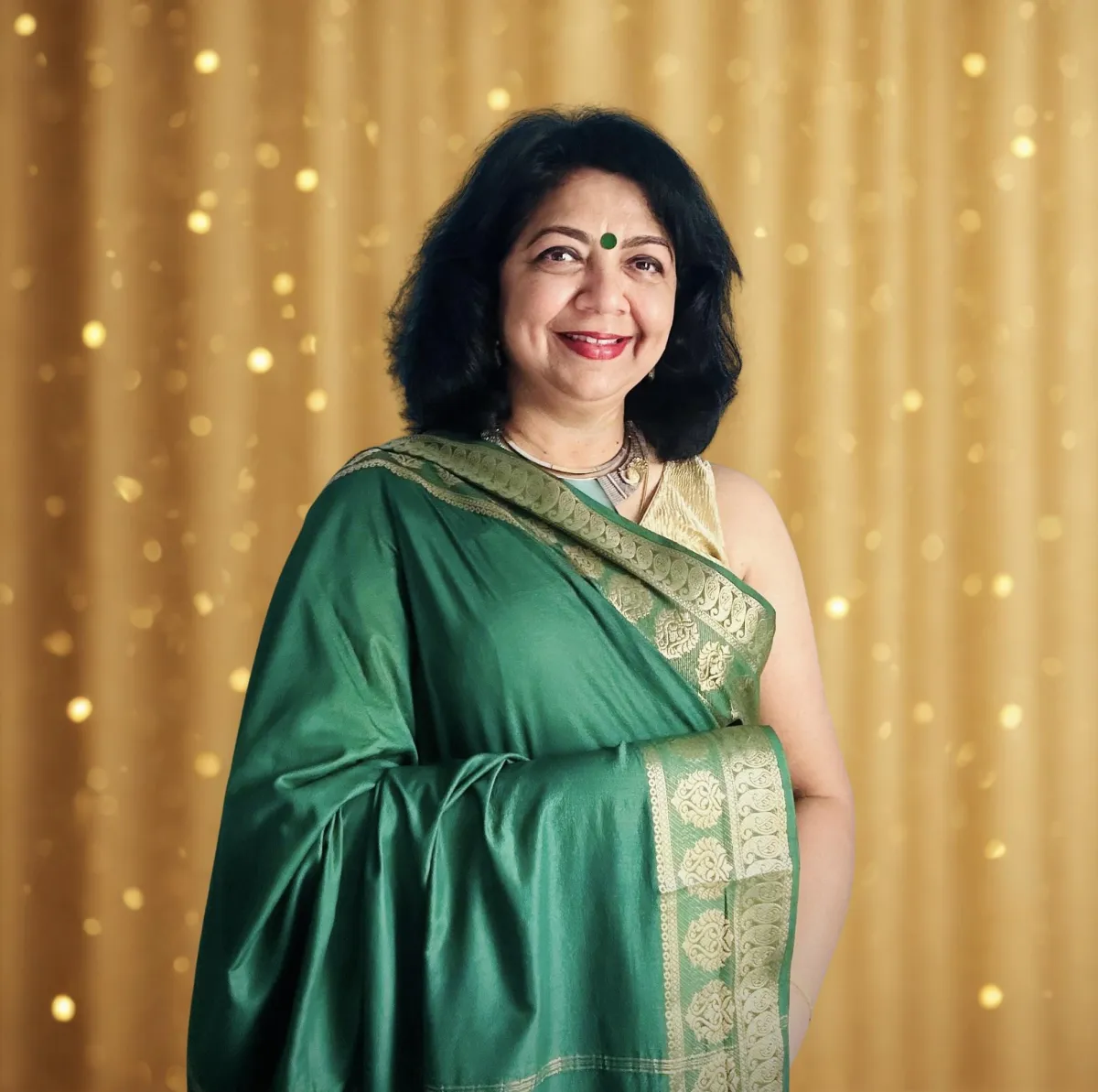
Hi, I'm Maya. Welcome to my kitchen.
There's warmth in every story stirred into these recipes.
A Pediatric Dentist by profession and storyteller by soul,
I bring the rhythms of South Indian cooking
into my American kitchen—
a blend of tradition, curiosity, and heart.
Whether you're here for a comforting breakfast,
a festive feast, or a family favorite, I hope these recipes
help you slow down, cook with confidence,
and create memories around your own table.
Thank you for letting me be a small part of your kitchen.
🌿 Cook with joy.
Join the Table 🌿
If this felt a little like sitting around a familiar table, you’ll feel at home here.
I share simple South Indian meals, seasonal cooking, pantry wisdom and quiet kitchen rhythms —
straight from my stove to your inbox.
I’d love to have you at the table. 🌿
No spam. Just simple recipes and quiet kitchen stories.
💬 I’d Love to Hear From You!
If this memory reminded you of someone you love, I'd be honored to hear their story too.
Your words, memories, and reflections mean the world to me.
Share your thoughts using the form below — I read every message.
Affiliate Disclosure:
Some links on this page are affiliate links. As an Amazon Associate,
I earn from qualifying purchases —at no extra cost to you.
I only recommend tools I personally use and trust in my own kitchen.
© 2026 Stirred By Spice | Designed with warmth 🌶️ & stories.s 🪔 All rights reserved
Some images on this site are AI-generated to reflect the spirit of home cooking.