
❤️ 🌾 Ragi Koozh — A Place in the Circle
A humble grain, a childhood memory, and the abundance I understood only years later.
❤️ Stories of Devotion
🌾 Ragi Koozh — A Place in the Circle
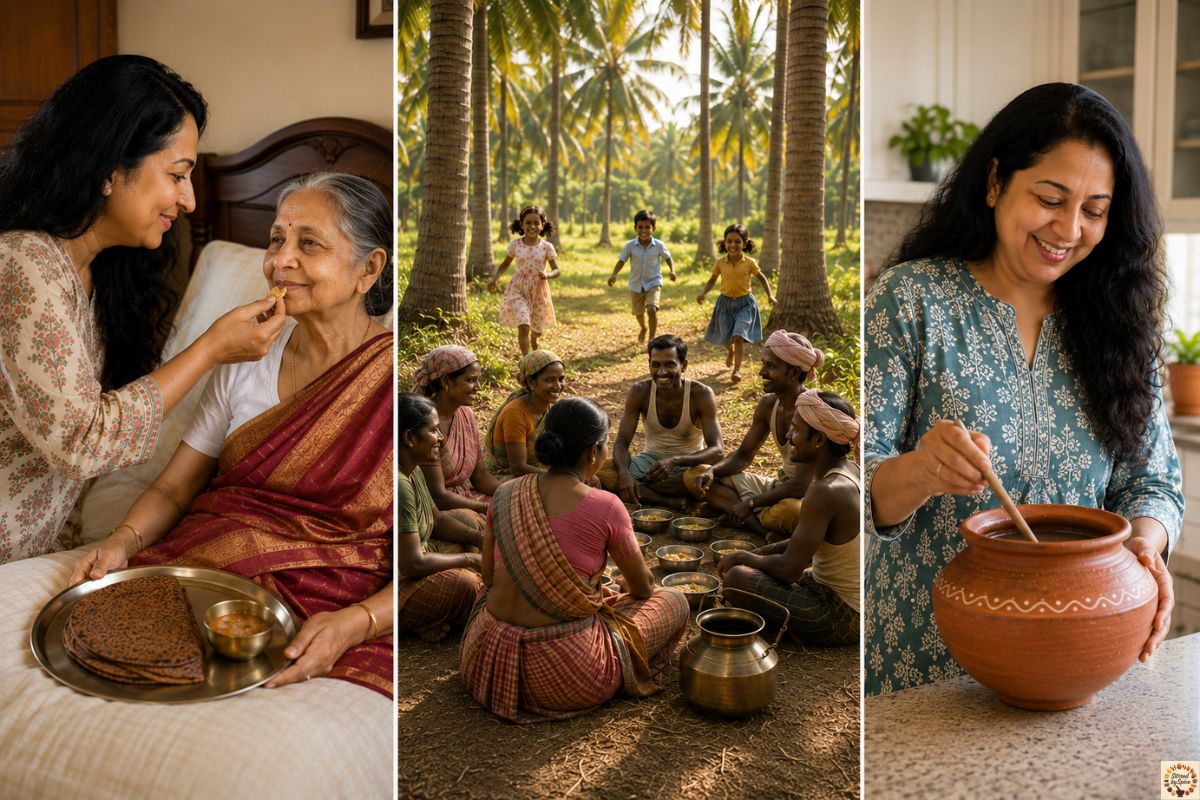
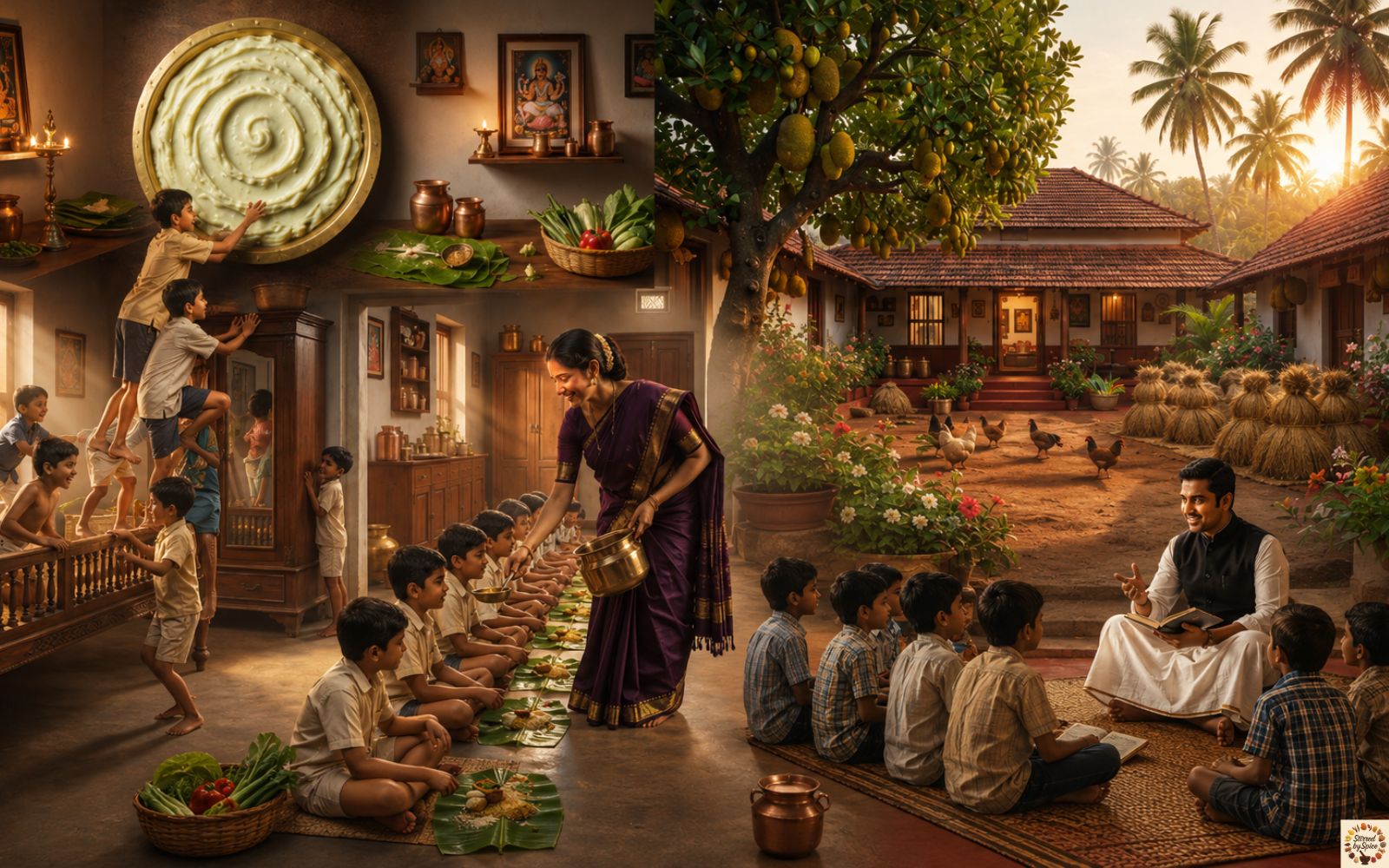
Photo by Stirred By Spice
My earliest memories of ragi were not particularly affectionate ones.
My maternal grandmother—my Dodda—lived with us for as long as I can remember.
In her later years, after she became diabetic and eventually bedridden,
her food had to be carefully monitored.
Most evenings, dinner meant ragi dosa.
I would carry her plate to her bedside, look at the soft brown dosa sitting there
and tell her with complete sincerity,
“Dodda, I don't know how you eat that rag-looking dosa with a smile.”
I had grown up loving crisp dosas made with rice.
This limp little thing on her plate made absolutely no sense to me.
Dodda would simply look at me with that quiet wisdom in her eyes.
She was one of the most diplomatic people I have ever known.
She had little formal education, yet through the way she lived, she taught me
the difference between being educated and being wise
without ever needing to put it into words.
I admired her strength.
I admired her grace.
I watched her meet extraordinary adversity
without allowing it to harden her.
But the ragi dosa?
That remained a mystery.
🌾
My other memory of ragi lived beneath the coconut palms on my parents' farm.
The people who worked there spent long hours under a blazing sun.
When lunchtime came, they would gather in the shade of the coconut trees
and sit on the hard clay earth together.
I remember the laughter.
That may be what has stayed with me most.
They worked extraordinarily hard and had very little materially,
yet when they sat together for lunch there was chatter, teasing and laughter—
the unmistakable sound of people finding joy in one another's company.
Their lunch was often simple: Ragi Koozh*, carried in a thooku or
sometimes a copper vessel with a thin handle.
It was inexpensive, sustaining food that could carry them
through hours of physical work in the heat.
We children would be running between the coconut trees, completely occupied
with whatever adventure had claimed us that afternoon.
And if we happened to wander near them while they were eating,
someone would invariably look up, smile and say
the sweetest of Tamil invitations:
“Vaanga, saappidalaam.”
Come. Let us eat.
We weren't expected.
They didn't have a table overflowing with food.
They didn't have much to spare at all.
And still, their instinct was to make the circle wider.
I would smile and answer,
“Illa, neenga saappidunga.”
No, you please eat.
And off we would run again between the coconut palms.
As a child, I thought they were offering me some of their koozh.
It took me years to understand that they were offering me something much larger.
A place in the circle.
Perhaps that is one reason food became such a powerful language of love for me.
I grew up in a culture where food was rarely understood
as belonging only to the person whose plate held it.
Someone arrived? Make room.
Someone was hungry? Share.
A child wandered past at lunchtime?
Vaanga, saappidalaam.
There might not always have been enough for everyone to have plenty.
Somehow, there was still enough to offer.
It was only after living far away from the place where I grew up that
I began to recognize how deeply that instinct had shaped me.
What I have may be small.
But there is room for you here.
(*Ragi Koozh is a traditional Tamil preparation made with ragi—finger millet—a humble grain
that has nourished generations of farming communities across South India.)
🌾
Years passed.
And this morning, for the first time in my life, I made Ragi Koozh.
The same woman who once looked suspiciously at her grandmother's ragi dosa
had gone looking for ragi recipes,
learned more about this humble grain,
and even bought herself
a traditional man paanai—an earthen clay pot—in which to serve her koozh.
Somewhere, I am quite certain, Dodda is laughing.
And she has earned it.
Because when I finally tasted my koozh, I discovered something
my younger self would never have believed:
I liked it.
As I drank it, however, something else returned.
I could almost hear laughter beneath the coconut palms.
I thought of those men and women working for hours beneath
the fierce sun and of the simple food that sustained them.
I thought about how much knowledge can live quietly inside
the foods people have eaten for generations,
long before someone gives them fashionable names or
tells us we ought to rediscover them.
And most of all, I remembered their generosity.
Their having little was never the beautiful part.
Their willingness to offer from the little they had was.
Perhaps that is why this first bowl of Ragi Koozh felt like more than
discovering a food I had misunderstood as a child.
It felt like recognizing something that had been placed before me a very long time ago.
The wisdom in Dodda's plate.
The nourishment inside a humble vessel of koozh.
The laughter beneath the palms.
And a simple invitation whose meaning I finally understand.
“Vaanga, saappidalaam.”
Come.
There is room.
Because sometimes abundance has very little to do with how much we possess.
Sometimes it is simply having enough in the heart to move over.
❤️
“As a child, I thought they were offering me their food. It took me years to understand that
they were offering me something much larger—a place in the circle.”
🌾 What the Ragi Knew
For years, ragi belonged to other people's plates.
It was Dodda's soft dosa at dinner—the one I could never understand
when crisp rice dosas were the measure by which I judged all dosas.
It was the koozh carried into the coconut fields by people who worked beneath a blazing sun
and somehow still had enough in their hearts to call out to passing children:
Vaanga, saappidalaam.
Come, let us eat.
I thought I knew what they were offering.
I didn't.
Years later, standing in my own kitchen in America, stirring ragi koozh in a clay pot
I had deliberately gone looking for, I finally understood something
the child beneath those coconut palms could not.
The koozh was food. The invitation was abundance.
Perhaps that is one of the quiet gifts of growing older.
Sometimes we become old enough to understand
what was being placed before us all along.
And somewhere, I imagine Dodda smiling at the granddaughter
who once looked suspiciously at her ragi dosa—
and now searches for new ways to cook with ragi.
❤️
Some lessons, apparently, take a little longer to ferment.
🌾
Vaanga, saappidalaam.
Come. There is room.
❤️
❤️ A Few More Stories to Savor
💛 Meet the Heart Behind the Spice

Hi, I'm Maya. Welcome to my kitchen.
There's warmth in every story stirred into these recipes.
A Pediatric Dentist by profession and storyteller by soul,
I bring the rhythms of South Indian cooking
into my American kitchen—
a blend of tradition, curiosity, and heart.
Whether you're here for a comforting breakfast,
a festive feast, or a family favorite, I hope these recipes
help you slow down, cook with confidence,
and create memories around your own table.
Thank you for letting me be a small part of your kitchen.
🌿 Cook with joy.
Join the Table 🌿
If this felt a little like sitting around a familiar table, you’ll feel at home here.
I share simple South Indian meals, seasonal cooking, pantry wisdom and quiet kitchen rhythms —
straight from my stove to your inbox.
I’d love to have you at the table. 🌿
No spam. Just simple recipes and quiet kitchen stories.
💬 I’d Love to Hear From You!
If this memory reminded you of someone you love, I'd be honored to hear their story too.
Your words, memories, and reflections mean the world to me.
Share your thoughts using the form below — I read every message.
Affiliate Disclosure:
Some links on this page are affiliate links. As an Amazon Associate,
I earn from qualifying purchases —at no extra cost to you.
I only recommend tools I personally use and trust in my own kitchen.
© 2026 Stirred By Spice | Designed with warmth 🌶️ & stories.s 🪔 All rights reserved
Some images on this site are AI-generated to reflect the spirit of home cooking.