
🌾 Ragi Koozh
Traditional Tamil Finger Millet Koozh
🌶️ Spice Level: 🌶️ Mild
⏱️ Prep Time: 10 minutes
🍲 Cook Time: 15-20minutes
Fermentation: Overnight, about 8–12 hours
🍽️ Serves: 4
📊Calories: ~approximately 150–180 per serving, depending on yogurt and additions
🏡 Pantries of Plenty
🌿 Introduction
Ragi Koozh is a traditional Tamil preparation made with ragi, or finger millet,
a grain that has nourished generations across South India.
Simple, sustaining and deeply rooted in everyday food traditions, koozh was especially valued by
people whose days demanded long hours of physical work beneath the heat of the sun.
For me, however, Ragi Koozh carries something beyond nourishment.
It carries the memory of coconut palms, laughter drifting across a farm at lunchtime,
and people who had very little to spare but whose first instinct was still to say:
“Vaanga, saappidalaam.”
Come. Let us eat.
I understood the food only much later.
Perhaps I understood the invitation first.
❤️
“The koozh was food. The invitation was abundance.”
❤️ Every Recipe Has a Story
Some foods return to us carrying far more than hunger.
Ragi Koozh brought back memories of my grandmother,
afternoons beneath the coconut palms,
and people who had very little materially yet
never hesitated to make room for one more person at their meal.
❤️ The story behind this bowl:
📖 Ragi Koozh — A Place in the Circle → Read the Story
Ragi Koozh
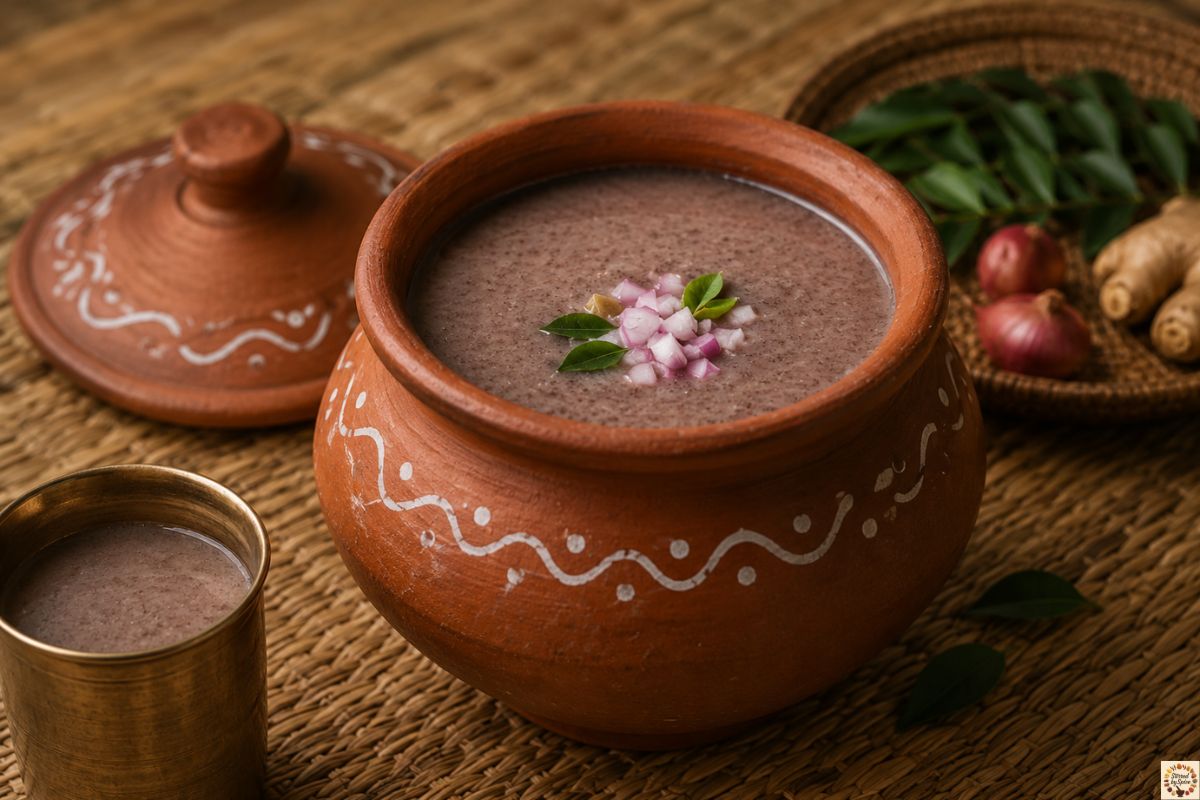
Photo by Stirred By Spice
📝 Ingredients
For the Ragi Koozh
1 cup ragi flour (finger millet flour)
3 cups water, divided, plus more as needed
1 cup plain yogurt
Salt, to taste
To Serve
¼–½ cup finely chopped small red onion or shallots
Fresh curry leaves, finely chopped, optional
Additional water, as needed to reach your preferred drinking consistency
Optional Tadka/Seasoning
1 teaspoon oil
½ teaspoon mustard seeds
½ teaspoon cumin seeds
1 small green chilli, finely chopped or slit
5–6 curry leaves
Pinch of asafoetida (hing), optional
🍽️ Instructions
Step 1 — Make the Ragi Slurry — Begin smooth
Place the ragi flour in a bowl and gradually whisk in about 1 cup of the water
until completely smooth and free of lumps.
Step 2 - Cook the Ragi — Stir until glossy
Bring the remaining 2 cups water to a gentle boil in a heavy-bottomed saucepan.
Reduce the heat and slowly pour in the ragi slurry, stirring continuously so that lumps do not form.
Cook over low to medium-low heat for approximately 15–20 minutes, stirring frequently, until the
mixture thickens considerably and the raw aroma of the ragi disappears.
The cooked ragi should look smooth and slightly glossy.
Step 3 - Cool Completely — Give it time
Remove from the heat and allow the cooked ragi mixture to cool completely to room temperature.
Do not add yogurt while the mixture is hot.
Step 4 - Ferment Overnight — Let time do the work
Cover loosely and leave the cooked ragi at room temperature overnight, approximately 8–12 hours,
to develop its characteristic gentle fermentation.
Fermentation time will vary depending on the warmth of your kitchen. In very warm weather, check it sooner.
Step 5- Add the Yogurt — Bring the koozh together
The following morning, stir the fermented ragi well.
Add 1 cup plain yogurt and salt to taste. Mix thoroughly, breaking up any thickened portions until
the koozh is smooth.
Add cool water gradually until it reaches the consistency you enjoy.
Traditionally, koozh can be made loose enough to drink, so don't be afraid to thin it considerably.
Step 6 - Add the Onion — Keep it beautifully simple
Stir in finely chopped red onion or shallots.
This is the version I made—simple, cooling and unseasoned.
Serve it cool or at room temperature.
Optional: Add a Tadka
For those who enjoy a little more fragrance and spice, you can finish the koozh
with a simple tempering.
Heat the oil in a small tadka pan.
Add the mustard seeds and allow them to splutter. Add cumin seeds, green chilli, curry leaves
and asafoetida, if using.
Let everything sizzle briefly until fragrant.
Pour the hot tadka over the prepared koozh and stir gently.
Both versions belong at the table—the quiet simplicity of the traditional bowl and the gently seasoned variation.
A Note About Koozh
Ragi is finger millet.
Koozh is a traditional Tamil preparation made by cooking and fermenting a grain—
here, ragi—into a nourishing porridge that may be thinned to a drinkable consistency.
It is pronounced approximately “koozh,” with the final Tamil ழ sound having no exact English equivalent.
And no, we will not be renaming it a smoothie. 😂
A koozh is a koozh is a koozh. 🌾
🧡 Curious what tools I use in my everyday kitchen?
You can find my trusted cookware and appliances here → My Kitchen Resources
🍷 Optional Serving Notes
Ragi Koozh is traditionally enjoyed cool, particularly during hot weather.
Serve it with finely chopped onions or shallots stirred through it.
Green chillies, curry leaves or the optional tadka can be added according to preference.
For a more traditional experience, serve it from a man paanai—an earthen clay pot—
and drink it from a tumbler or glass.
Not necessary, of course.
But some of us have apparently committed fully to the assignment. 😂🌾
💬 Soulful Note
Some foods nourish us before we understand their wisdom.
Perhaps growing older is simply learning to recognize what was quietly feeding us all along.
🌾
❤️
📚 Cook’s Wisdom / FAQs
👩🍳Cook's Wisdom:
Ragi thickens considerably as it cooks and rests, so don't judge the final consistency while it is still on the stove.
Once fermented and mixed with yogurt, add water gradually until the koozh reaches the consistency you prefer.
And give the fermentation time rather than watching the clock too rigidly. A warm Tamil kitchen and
an air-conditioned American kitchen are very different environments.
Look for a gentle fermented aroma and slight tang rather than relying only on the number of hours.
💡Helpful Tips
Whisk the ragi with cool water first. Making a smooth slurry before it reaches the stove is the
easiest way to prevent lumps.
Keep stirring while the ragi cooks. Ragi thickens quickly and can catch at the bottom of the pan,
especially toward the end of cooking.
Cool completely before fermenting. Let the cooked ragi reach room temperature before covering
and leaving it to ferment.
Let your kitchen guide the fermentation. In a warm kitchen, the koozh may develop its gentle tang
sooner than it would in a cooler, air-conditioned home.
Adjust the consistency only after adding yogurt. The fermented ragi will be quite thick. Add cool water
gradually until it is as spoonable—or drinkable—as you like.
Keep the onions fresh. Add chopped onion or shallots shortly before serving for the best flavor and texture.
Try it both ways. Begin with the simple yogurt-and-onion version, then try the optional tadka another time.
They offer two slightly different experiences of the same humble bowl.
❓FAQ
Can I make Ragi Koozh without fermenting it?
Yes, you can eat cooked ragi with yogurt without fermenting it, but fermentation gives traditional koozhits characteristic gentle tang and deeper flavor.
How do I know when the ragi is properly cooked?
The mixture will become thick, smooth and slightly glossy, and the raw flour aroma will disappear.Give it the full cooking time rather than judging only by thickness.
How do I know when it has fermented enough?
Look for a mild fermented aroma and a pleasant tang. Fermentation time varies with room temperature,so the koozh itself is a better guide than the clock.
Why is my koozh so thick the next morning?
Perfectly normal. Ragi continues absorbing water as it rests. Once you add the yogurt, thin it graduallywith cool water until you reach the consistency you prefer.
Can I use buttermilk instead of yogurt?
Yes. Buttermilk is traditionally used in many versions of Ragi Koozh. I use plain yogurt and water,which allows me to adjust the tang and consistency easily.
Should Ragi Koozh be eaten or drunk?
Either! It can be kept thicker and eaten with a spoon or thinned until drinkable. There is no need toturn it into a smoothie to accomplish this. 😂🌾
Can I make it ahead?
Yes. The cooked ragi is naturally prepared ahead because it ferments overnight. Once yogurt andfresh onions are added, refrigerate leftovers promptly and enjoy them chilled.
📊 Nutrition (Per Serving — Approx.)
Calories - 150-180 kcal
Protein- 5-6 g
Carb- 27-30 g
Fat-2-4 g
Fiber-3-4 g
Calcium: varies depending on the ragi flour and yogurt used
Nutrition values are estimates and will vary depending on ingredients, yogurt and serving consistency.
If You’d Like to Go Deeper..
Many of the dishes on this page are built on quiet spice knowledge —
the kind learned slowly, through observation, repetition, and care.
If you’d like a deeper understanding of Indian spices and everyday masalas —
how to choose them, use them, and build confidence over time —
you may enjoy the guide I’ve created alongside this kitchen.
🍃🌶🍃 The Bottom Line
There are foods we learn to love immediately.
And there are foods whose wisdom waits patiently for us to catch up.
For years, ragi belonged to my grandmother's plate and to the thookus carried beneath the coconut palms.
Then one morning, many years later and thousands of miles away, it found its way into my own man paanai.
Perhaps Dodda knew something I didn't.
Perhaps the workers beneath those palms did too.
Some lessons, apparently, take a little longer to ferment. 🌾❤️
Vaanga, saappidalaam.
Come. There is room.
💛 Meet the Heart Behind the Spice

Hi, I'm Maya. Welcome to my kitchen.
There's warmth in every story stirred into these recipes.
A Pediatric Dentist by profession and storyteller by soul,
I bring the rhythms of South Indian cooking
into my American kitchen—
a blend of tradition, curiosity, and heart.
Whether you're here for a comforting breakfast,
a festive feast, or a family favorite, I hope these recipes
help you slow down, cook with confidence,
and create memories around your own table.
Thank you for letting me be a small part of your kitchen.
🌿 Cook with joy.
Join the Table 🌿
If this felt a little like sitting around a familiar table, you’ll feel at home here.
I share simple South Indian meals, seasonal cooking, pantry wisdom and quiet kitchen rhythms —
straight from my stove to your inbox.
I’d love to have you at the table. 🌿
No spam. Just simple recipes and quiet kitchen stories.
💬 I’d Love to Hear From You!
Your words, memories, and reflections mean the world to me.
Share your thoughts using the form below — I read every message.
Affiliate Disclosure:
Some links on this page are affiliate links. As an Amazon Associate,
I earn from qualifying purchases —at no extra cost to you.
I only recommend tools I personally use and trust in my own kitchen.
© 2026 Stirred By Spice | Designed with warmth 🌶️ & stories.s 🪔 All rights reserved
Some images on this site are AI-generated to reflect the spirit of home cooking.