
🌿🥕 Vegetable Kurma
(South Indian Mixed Vegetable Kurma)
A creamy South Indian vegetable curry where coconut, poppy seeds, and spices transform
everyday vegetables into pure comfort.
🌶️ Spice Level: 🌶️ Mild-Medium
⏱️ Prep Time: 20 minutes
🍲 Cook Time: 30 minutes
🍽️ Serves: 4-6
📊Calories: ~220 per serving
🪴 Kitchen Garden & Beyond
🌿 Introduction
Vegetable Kurma is one of South India's most beloved comfort dishes.
Served alongside Idiyappam, Appam, Dosa, Chapati, or Parotta, this fragrant curry
transforms simple vegetables into something rich, nourishing, and deeply satisfying.
The combination of coconut, cashews, poppy seeds, and warming spices creates a velvety gravy
that feels both festive and familiar—perfect for family breakfasts, special occasions, or everyday meals.
“Sometimes the simplest vegetables create the most memorable meals.”
Vegetable Kurma
(South Indian Mixed Vegetable Kurma)
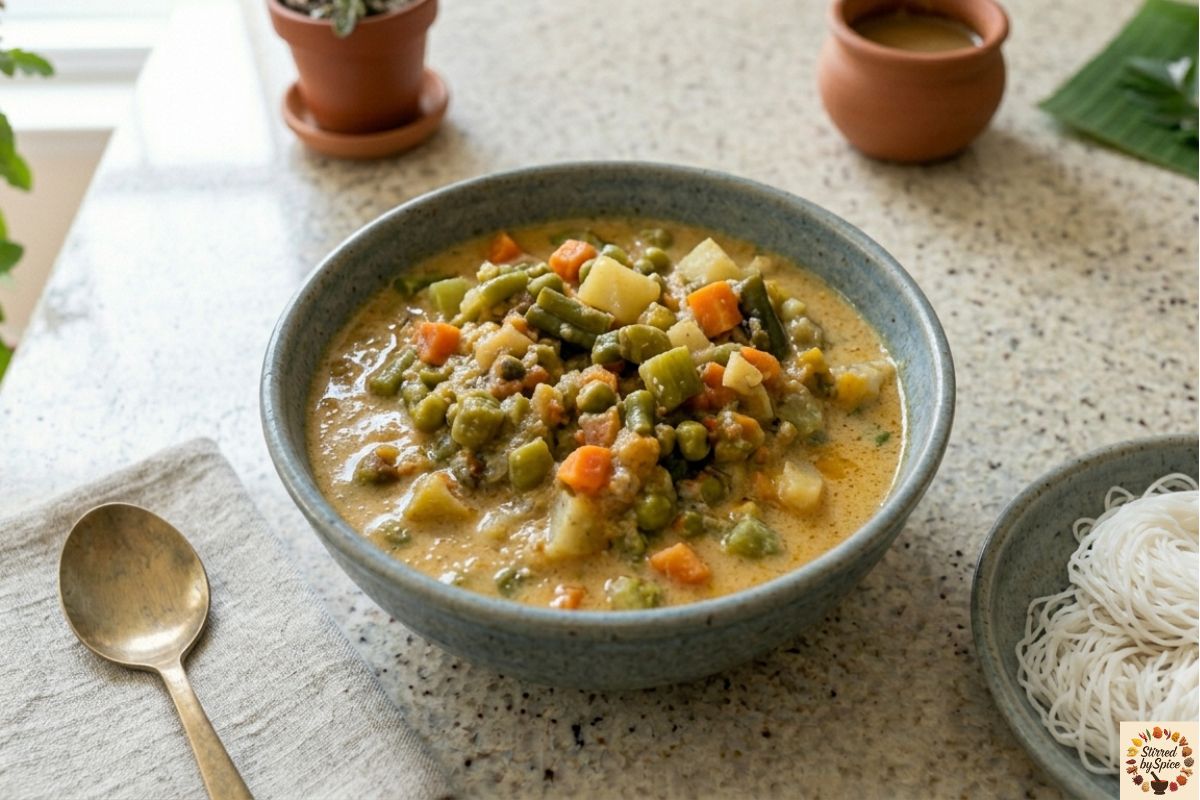
Photo by Stirred By Spice
📝 Ingredients
🥥 For the White Paste
6 whole cashews
1 teaspoon white poppy seeds (khus khus)
4 tablespoons fresh grated coconut
¼ cup water
🥕For Cooking the Vegetables
½ cup potato, chopped
½ cup beans, chopped
½ cup carrots, chopped
½ cup green peas
½ cup chow chow (chayote), chopped
½ teaspoon salt
½ teaspoon turmeric powder
1 cup water
🌿 Whole Spices
1 bay leaf
2 cardamom pods
3 cloves
1 small cinnamon stick
2 green chilies, slit
🌶️ Spice Powders
1 teaspoon red chili powder
½ teaspoon turmeric powder
2 teaspoons coriander powder
1 teaspoon salt
🧅 Other Ingredients
2 tablespoons oil
1 teaspoon ghee
2 medium onions, finely chopped
2 teaspoons ginger garlic paste
3 medium tomatoes, finely chopped
¼ cup curd, whisked
½ cup milk, warmed
1 teaspoon garam masala powder
4 sprigs coriander leaves, chopped
🍽️ Instructions
Step 1 — Prepare the White Paste
Blend the cashews, poppy seeds, coconut, and water into a smooth paste.
Set aside.
Step 2 — Cook the Vegetables
Cook the vegetables with salt, turmeric, and water until tender but not mushy.
If using a pressure cooker, cook for 2 whistles and allow pressure to release naturally.
Set aside.
Step 3 —Build the Base
Heat oil and ghee in a pan.
Add bay leaf, cardamom, cloves, cinnamon, and green chilies.
Sauté for 10 seconds until fragrant.
Step 4 — Cook the Onions & Tomatoes
Add onions and cook until soft.
Add ginger garlic paste and tomatoes.
Cook for 4–5 minutes until the tomatoes break down and the oil begins to separate.
Step 5 —Add the Vegetables
Add the cooked vegetables.
Stir in red chili powder, turmeric powder, coriander powder, and salt.
Cook for 1 minute.
Step 6 — Create the Kurma
Add the prepared white paste, garam masala, and whisked curd.
Allow the mixture to simmer gently for 2 minutes.
Step 7 — Finish the Curry
Pour in the warm milk.
Bring to a gentle boil.
Switch off the heat.
Garnish with chopped coriander leaves.
Serve warm.
🧡 Curious what tools I use in my everyday kitchen?
You can find my trusted cookware and appliances here → My Kitchen Resources
For the Curious Home Cook
Spices are more than heat or color — they’re the quiet backbone of everyday Indian cooking.
Used with care, they bring warmth, balance, and depth to even the simplest meals.
If you’ve ever wondered why certain spices are paired together, or how masalas shape flavor without overwhelming it,
I’ve gathered those foundations into a gentle, practical guide.
💬 Soulful Note
Sometimes comfort comes not from elaborate ingredients but from simple vegetables
brought together with care.
Vegetable Kurma reminds us that everyday meals can be deeply nourishing.
📚 Cook’s Wisdom / FAQs
👩🍳Cook's Wisdom:
Whisk the curd thoroughly before adding to prevent splitting.
Add the milk only after reducing the heat to keep the gravy smooth and creamy.
Cook the vegetables until tender but not mushy so they hold their shape in the kurma.
The white paste is the heart of this recipe—blend it until completely smooth for the best texture.
💡Helpful Tips
✨ Use freshly grated coconut whenever possible for the richest flavor.
✨ Pressure cook vegetables separately to maintain better texture control.
✨ If the kurma thickens after resting, add a splash of warm milk before serving.
✨ This kurma tastes even better after 30 minutes as the flavors settle together.
✨ For restaurant-style richness, add an extra tablespoon of cashews to the white paste.
❓FAQ
Why is my kurma not creamy?
The white paste may not have been blended smoothly enough. Blend until silky and lump-free.
Can I make Vegetable Kurma ahead?
Yes. It reheats beautifully and often tastes even better the next day.
Can I skip the poppy seeds?
Yes. Increase the cashews slightly for a similar creamy texture.
What vegetables work best?
Potatoes, carrots, beans, peas, chow chow, cauliflower, and potatoes are all excellent choices.
Is this spicy?
Mild to medium. Adjust the green chilies and chili powder according to taste.
What pairs best with Vegetable Kurma?
Idiyappam, Appam, Dosa, Chapati, Parotta, Poori, and Semige.
📊 Nutrition (Per Serving — Approx.)
Calories 220 kcal
Protein 5 g
Carb- 20 g
Fat-14 g
Fiber: 4 g
Sugar: 5 g
Sodium: 450 mg
🍳 Helpful Kitchen Equipment
The right kitchen tools make everyday cooking smoother and more enjoyable. These are the essentials I regularly use in my kitchen for preparing Indian meals with ease.
• Pressure Cooker / Instant Pot – Perfect for cooking rice dishes, lentils, and one-pot meals quickly while preserving flavor and texture.
• High-Speed Blender – Ideal for chutneys, spice pastes, and smooth gravies that form the base of many Indian recipes.
• Stainless Steel Kadai – A versatile pan for sautéing spices, simmering curries, and building deep layered flavors.
You can find all my everyday kitchen essentials on my Kitchen Resources page here →
If You’d Like to Go Deeper..
Many of the dishes on this page are built on quiet spice knowledge —
the kind learned slowly, through observation, repetition, and care.
If you’d like a deeper understanding of Indian spices and everyday masalas —
how to choose them, use them, and build confidence over time —
you may enjoy the guide I’ve created alongside this kitchen.
Join the Table 🌿
If this felt a little like sitting around a familiar table, you’ll feel at home here.
I share simple South Indian meals, seasonal cooking, pantry wisdom and quiet kitchen rhythms —
straight from my stove to your inbox.
I’d love to have you at the table. 🌿
No spam. Just simple recipes and quiet kitchen stories.
🍃🌶🍃 The Bottom Line
Creamy, fragrant, and deeply comforting, Vegetable Kurma is one of those
timeless South Indian dishes that turns an everyday meal into something memorable.
Looking for more gentle summer meals?
Explore my June Seasonal Produce Guide
for seasonal South Indian cooking inspiration 🌿
🧡 Meet the Heart Behind the Spice

Hi, I’m Maya Shetty — cook, storyteller, and spice lover.
Through Stirred By Spice, I share recipes that warm both the kitchen and the heart — where simple ingredients and warm flavors turn everyday meals into moments of connection.
💬 I’d Love to Hear From You!
Your words, memories, and reflections mean the world to me.
Share your thoughts using the form below — I read every message.
Affiliate Disclosure:
Some links on this page are affiliate links. As an Amazon Associate,
I earn from qualifying purchases —at no extra cost to you.
I only recommend tools I personally use and trust in my own kitchen.
© 2026 Stirred By Spice | Designed with warmth 🌶️ & stories.s 🪔 All rights reserved
Some images on this site are AI-generated to reflect the spirit of home cooking.