
🥣 Mixed Dal Khichdi
A protein-rich rice, lentil and vegetable khichdi finished with a fragrant two-stage tempering.
🌶️ Spice Level: 🌶️🌶️ Medium
⏱️ Prep Time: 10 minutes + 30 minutes soaking
Cooling Time:About 30 minutes
🍽️ Serves: 5-6
Calories: ~460 per serving
🏡 Pantries of Plenty
🌿 A Bowl Made for Quiet Days
There are some meals we cook because we want something elaborate,
and others we turn to because we want dinner—or breakfast—
to feel uncomplicated.
Khichdi belongs beautifully to the second kind.
Rice and lentils cook together until soft and comforting, becoming the sort of meal
that asks very little of you once it reaches the bowl.
This version uses both moong dal and masoor dal, along with a generous handful of vegetables,
making it a hearty one-pot meal
while keeping everything wonderfully simple.
But simple doesn't have to mean plain.
Here, rice, lentils and vegetables are pressure-cooked together until tender,
then folded into an onion-tomato masala fragrant with whole spices.
A second tempering of cumin, dried red chillies and Kashmiri chilli powder
goes over the finished khichdi,
bringing one last warm bloom of spice to the pot.
Fried onions and fresh cilantro on top provide just enough contrast to all that softness.
🥣
“Some meals don't ask to impress us.
They simply arrive warm, nourishing,
and exactly when we need them.”
❤️
Mixed Dal Khichdi
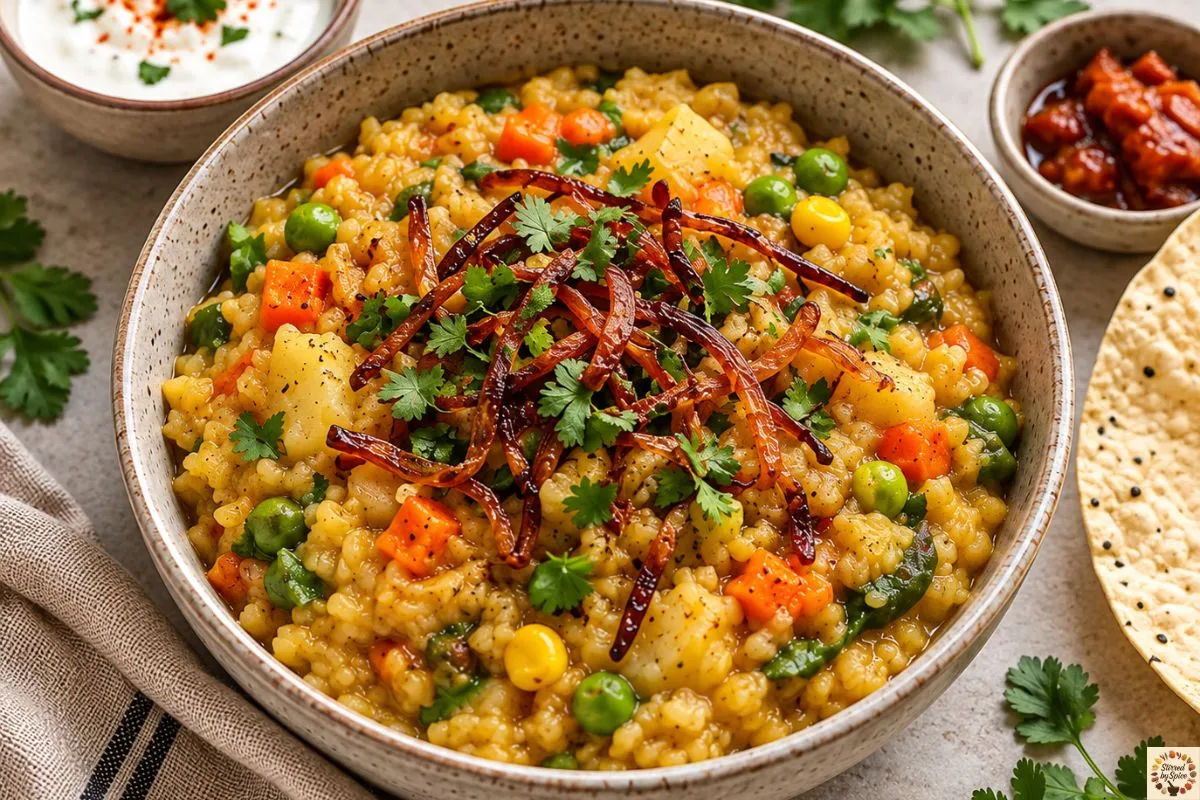
Photo by Stirred By Spice
📝 Ingredients
For the Rice, Lentils & Vegetables
1 cup rice
¾ cup moong dal
¾ cup masoor dal
Potato, diced
Carrots, diced
Green beans, chopped
Corn
Green peas
1 teaspoon salt
¼ teaspoon turmeric powder
Water, as needed
Note: Use the vegetables in whatever combination and quantity suits your pot. This is an especially good recipe
for using small amounts of vegetables already waiting in the refrigerator or freezer.
For the First Tempering & Masala
1 tablespoon ghee
1½ tablespoons oil
½ teaspoon shah jeera (black cumin seeds)
3 green cardamom pods
1 black cardamom pod
1 bay leaf
4 cloves
½-inch cinnamon stick
1 medium onion, sliced
1 teaspoon ginger-garlic paste
1 medium tomato, sliced
1 teaspoon salt
1½ teaspoons chilli powder
1 teaspoon coriander powder
1 teaspoon cumin powder
½ teaspoon garam masala
For the Second Tempering
1 tablespoon ghee
1 tablespoon oil
1 teaspoon cumin seeds
2 dried red chillies
½ teaspoon Kashmiri red chilli powder
For Garnishing
Fried onions, as desired
Fresh cilantro, chopped
🍽️ Instructions
Step 1. Wash & Soak — Prepare the rice and dals
Add the rice, moong dal and masoor dal to a large bowl. Rinse thoroughly until the water runs mostly clear,
then cover with fresh water and soak for 30 minutes. Drain before cooking.
Step 2. Pressure Cook — Add the vegetables
Transfer the drained rice and dals to the Instant Pot. Add the potato, carrots, beans, corn and peas
along with the salt and turmeric.
Add enough water to sit approximately 1 inch above the rice, lentils and vegetables.
Close the lid and cook for 15 minutes on the Multigrain setting. Allow the pressure to release naturally.
The finished mixture should be very soft, with the rice and lentils melding together and the vegetables tender.
Pressure Cooker Method: Cook for approximately 4 whistles, then allow the pressure to release
naturally before opening.
Step 3. Bloom the Whole Spices — Build the first layer
Heat a medium pot over medium heat. Add the ghee and oil.
Add the shah jeera, green cardamom, black cardamom, bay leaf, cloves and cinnamon.
Let the spices gently sizzle until fragrant.
Step 4. Build the Masala — Soften the aromatics
Add the sliced onion and sauté until soft and translucent.
Stir in the ginger-garlic paste and cook until its raw aroma disappears.
Add the tomato and salt. Cook until the tomato becomes soft and begins to break down.
Step 5. Add the Ground Spices — Deepen the flavor
Add the chilli powder, coriander powder, cumin powder and garam masala.
Stir well and cook briefly, allowing the spices to bloom into the onion-tomato mixture.
Step 6. Bring It Together — Add the cooked khichdi
Add the cooked rice, dal and vegetable mixture to the masala.
Mix until everything is evenly combined. Add a little hot water if needed to reach your preferred
consistency and adjust the salt to taste.
Step 7. Make the Final Tadka — Wake up the pot
Heat the remaining ghee and oil in a small frying or tadka pan.
Add the cumin seeds and dried red chillies and let the cumin crackle.
Lower the heat before adding the Kashmiri red chilli powder. Swirl it briefly through the hot fat
and immediately pour the fragrant tadka over the khichdi.
Step 8. Garnish — Add freshness and texture
Finish with fried onions and freshly chopped cilantro.
Step 9. Serve — Bring it to the table warm
Serve hot with plain yogurt, Indian pickle and crisp papad.
🧡 Curious what tools I use in my everyday kitchen?
You can find my trusted cookware and appliances here → My Kitchen Resources
🍷 Optional Serving Notes
Serve Mixed Dal Khichdi with cool plain yogurt or raita,
a spoonful of tangy Indian pickle and roasted or fried papad.
For an especially comforting bowl, finish with a small spoonful of warm ghee.
💬 Soulful Note
There is something wonderfully hopeful about an upside-down cake.
You do all the work without being able to see the part that will eventually become the top.
And then comes the moment when you simply have to turn it over and trust
what has been taking shape underneath.
Sometimes we don't know whether we're looking at a mess or a structure until we make the flip.
🥣
📚 Cook’s Wisdom / FAQs
👩🍳Cook's Wisdom:
Khichdi is forgiving by nature.
A handful of vegetables can change with the season. The consistency can be loosened with water.
The combination of dals can shift according to the pantry.
What matters more than precision is understanding the few things that make it work: cook the grains
and lentils until truly tender, build flavor in layers, and adjust the consistency before it reaches the table.
Once you understand those things, khichdi stops being a recipe you have to memorize and
becomes a meal you know how to make.
🌿 Helpful Tips
Let softness be the goal
Unlike pulao or biryani, khichdi isn't asking you to preserve perfectly separate grains of rice.
The soft texture is intentional. Rice and dal should begin to meld together.
Use the vegetables you have
Potatoes and carrots add body, while peas, beans and corn bring color and texture.
Fresh or frozen vegetables both work well, making this an excellent pantry-and-freezer meal.
Adjust the consistency after cooking
Khichdi continues to absorb liquid as it rests. Keep some hot water nearby and loosen it
before serving if necessary.
Don't burn the final chilli tempering
Kashmiri chilli powder can scorch quickly in hot fat. Lower the heat—or briefly remove the pan
from the heat—before stirring it in, then immediately pour the tadka over the khichdi.
Reheat gently
Leftover khichdi will be considerably thicker the following day. Add water a little at a time
while reheating until it becomes soft and spoonable again.
🔎 Khichdi Questions, Answered
Why does khichdi thicken as it sits?
Both rice and lentils contain starches that continue absorbing moisture after cooking.
As the khichdi cools and rests, there is less free liquid in the pot, so its texture naturally becomes thicker.
This isn't a sign that anything has gone wrong. Simply add a little hot water while reheating
and stir until the consistency returns to the way you like it.
How much water should I use for khichdi?
There isn't one perfect ratio because the amount depends on the varieties of rice and dal, whether they
have been soaked, how many vegetables you add and how soft you prefer your khichdi.
For this recipe, rather than relying on a rigid ratio, add enough water to sit approximately
1 inch above the rice, dal and vegetable mixture before pressure cooking.
If the finished khichdi is thicker than you like, hot water can easily be added afterward.
Why do we add tadka to khichdi at the end?
The final tadka isn't simply decorative.
When cumin and dried chillies hit hot ghee and oil, their aromatic compounds are released into the fat.
Pouring that fragrant fat over the finished khichdi carries those aromas across a dish whose underlying
flavors are otherwise soft and mellow.
This recipe actually uses two layers of tempering: whole spices flavor the onion-tomato masala,
while the final cumin-and-chilli tadka provides a fresh aromatic finish.
Can I use other dals?
Yes. Khichdi is wonderfully adaptable.
Moong dal contributes softness and a mild flavor, while masoor dal cooks quickly and blends easily into the rice.
Other dals can be incorporated, but firmer varieties such as chana dal may require adjustments
to soaking and cooking time.
Can I make khichdi with frozen vegetables?
Absolutely. Peas, corn, carrots and green beans are particularly convenient freezer staples for khichdi.
They can generally go directly into the pressure cooker without thawing first.
Why is my khichdi too thick the next day?
That's normal. The cooked rice and lentils continue absorbing moisture in the refrigerator.
Add a splash of water before reheating and continue adding a little at a time until
the original consistency returns.
📊 Nutrition (Per Serving — Approx.)
Calories: ~460 kcal
Carbohydrates: ~65–70 g
Protein: ~16–18 g
Fat: ~13–15 g
Fiber: ~10–12 g
If You’d Like to Go Deeper..
Many of the dishes on this page are built on quiet spice knowledge —
the kind learned slowly, through observation, repetition, and care.
If you’d like a deeper understanding of Indian spices and everyday masalas —
how to choose them, use them, and build confidence over time —
you may enjoy the guide I’ve created alongside this kitchen.
🍃🌶🍃 The Bottom Line
Mixed Dal Khichdi is pantry cooking at its most generous: rice, two everyday lentils,
vegetables and familiar spices transformed into something warm enough
to feel comforting and substantial enough to be a complete meal.
The double tempering gives this version its character, but underneath all those fragrant spices
it remains wonderfully simple:
a nourishing pot made from what you already have.
❤️
💛 Meet the Heart Behind the Spice

Hi, I'm Maya. Welcome to my kitchen.
There's warmth in every story stirred into these recipes.
A Pediatric Dentist by profession and storyteller by soul,
I bring the rhythms of South Indian cooking
into my American kitchen—
a blend of tradition, curiosity, and heart.
Whether you're here for a comforting breakfast,
a festive feast, or a family favorite, I hope these recipes
help you slow down, cook with confidence,
and create memories around your own table.
Thank you for letting me be a small part of your kitchen.
🌿 Cook with joy.
Join the Table 🌿
If this felt a little like sitting around a familiar table, you’ll feel at home here.
I share simple South Indian meals, seasonal cooking, pantry wisdom and quiet kitchen rhythms —
straight from my stove to your inbox.
I’d love to have you at the table. 🌿
No spam. Just simple recipes and quiet kitchen stories.
💬 I’d Love to Hear From You!
Your words, memories, and reflections mean the world to me.
Share your thoughts using the form below — I read every message.
Affiliate Disclosure:
Some links on this page are affiliate links. As an Amazon Associate,
I earn from qualifying purchases —at no extra cost to you.
I only recommend tools I personally use and trust in my own kitchen.
© 2026 Stirred By Spice | Designed with warmth 🌶️ & stories.s 🪔 All rights reserved
Some images on this site are AI-generated to reflect the spirit of home cooking.