
🍐 How to Choose, Store & Prepare Pears
Simple care, everyday ease, and confident cooking with pears
🪴 Kitchen Garden & Beyond
🌿 Introduction
Pears can be a little deceptive.
Unlike many fruits, they are often best brought home while still firm and
allowed to finish ripening on the counter.
One day they seem nowhere near ready—and then suddenly, there is a very small window between
perfectly ripe and perhaps we should make chutney immediately. 😂🍐
But once you know what to look for, pears become wonderfully easy to choose,
ripen, store, and cook with.
This guide will help you understand when a pear is ready, how to keep it at its best,
and how to bring its gentle sweetness into both savory and sweet dishes.
“Some fruits arrive ready to be eaten. Pears ask us to bring them home and give them a little time.”
How to Choose, Store & Prepare Pears
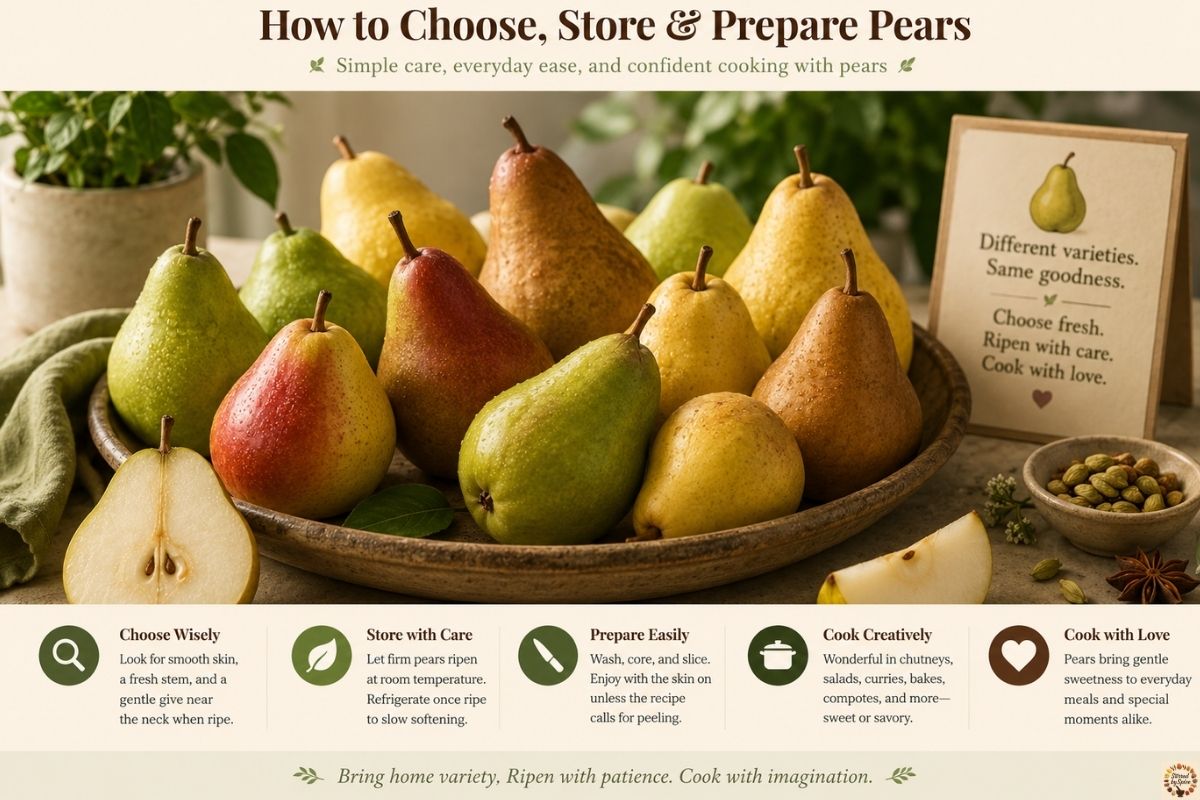
Photo by Stirred By Spice
📝 How to Choose Pears
Choose pears with smooth, intact skin and no deep bruises, cuts, or damaged areas.
Don't reject a pear simply because it feels firm. Many pears are harvested mature but firm and
continue ripening after purchase.
For pears that are ready to eat, gently press near the neck, just below the stem. A slight give
usually indicates ripeness.
Avoid squeezing the widest part of the fruit repeatedly—it can bruise delicate ripe pears.
Remember that color isn't a universal ripeness test. Different pear varieties naturally have different
colors and some change very little as they ripen.
🍐 Different Pears, Different Personalities
Just as we discovered with brinjal, different varieties are supposed to look—and behave—a little differently.
You may encounter:
Bartlett — classic pear shape; juicy, sweet and aromatic when ripe.
Bosc — elongated with brownish russeted skin; firmer texture that holds up beautifully in cooking.
Anjou — green or red; juicy and versatile, with relatively little color change as it ripens.
Comice — particularly soft, sweet and juicy when ripe; lovely for eating fresh.
Asian pears — rounder and crisp rather than buttery-soft, and generally eaten while still firm.
So if two pears don't look or feel alike, that doesn't necessarily mean one is better than the other.
Learn the variety—and then let the pear tell you when it's ready.
🍐
📝 How to Store Pears
Keep firm, unripe pears at room temperature while they ripen.
Check them daily near the stem rather than repeatedly squeezing the entire fruit.
Once ripe, move pears to the refrigerator to slow further ripening.
Keep cut pears refrigerated in a covered container.
A little lemon juice can help slow browning on exposed cut surfaces.
💛 Kitchen Wisdom: Don't refrigerate a hard pear and then wonder why it appears to have
entered a long-term lease agreement with the crisper drawer. 😂
Let it ripen first; refrigerate when ready.
📝 How to Prepare Pears
Wash well before cutting.
Pears can usually be eaten with the skin on; peel only when the recipe or desired texture calls for it.
Cut into quarters or halves and remove the core and seeds.
Slice or dice for salads, yogurt bowls, chutneys, pachadi, or desserts.
Firmer varieties can be cooked, baked, poached, roasted, or simmered without immediately collapsing.
🌿 Pears in the Indian Kitchen
Pears work surprisingly well with the Indian pantry.
Try them with:
Ginger • Cardamom • Cinnamon • Cloves • Black Pepper • Lemon
• Yogurt • Jaggery • Nuts • Fresh Herbs
Their gentle sweetness makes them particularly lovely in
chutneys, pachadi, spiced compotes, cakes and lightly spiced savory preparations.
A ripe pear doesn't always have to become dessert.
Sometimes it just needs ginger and a little imagination. 🍐🌿
💬 Soulful Note
Some ingredients reveal themselves immediately.
Others ask us to wait, notice, and learn when they are ready.
Perhaps that is part of cooking too—not simply knowing what to do, but learning when not to hurry.
🍐🌿
📚 Cook’s Wisdom / FAQs
📚Cook's Wisdom:
Check the neck, not the belly. Gentle pressure near the stem is one of the simplest ways
to judge whether many common pears are ready to eat.
Let firm pears ripen at room temperature. Once they reach the texture you like,
refrigeration can help slow further ripening.
Choose the variety for the job. Soft, juicy pears are wonderful eaten fresh; firmer varieties
can be especially useful when you want slices or pieces to retain their shape during cooking.
Don't fear a little russeting. Brownish or rough-looking skin can be a natural characteristic
of some pear varieties—Bosc being the obvious example—and isn't automatically a sign of poor quality.
Use very ripe pears rather than wasting them. Chutney, compote, cake, yogurt, oatmeal,
or a gently spiced fruit preparation can give a pear approaching peak softness somewhere delicious to go.
❓ Frequently Asked Questions
Why are the pears I bought so hard?
They may simply need time. Many pears are sold firm and finish ripening after youbring them home. Leave them at room temperature and check them regularly.
How can I tell when a pear is ripe?
For many common varieties, press gently near the neck beside the stem. If it yieldsslightly, the pear is usually ready to eat. Variety matters, however—
Asian pears, for example, are naturally crisp when ripe.
Should pears be refrigerated?
Firm pears are generally better allowed to ripen at room temperature.Once ripe, refrigerating them can help slow further softening.
Can I eat pear skin?
Yes. Pear skin is edible. Wash the fruit well and leave the skin on unless theparticular recipe or texture you're after benefits from peeling.
Why did my cut pear turn brown?
Exposure to air causes enzymatic browning. It is normal. If appearance matters,a little lemon or other acidic citrus juice can help slow the process.
Which pears are best for cooking?
A firmer pear that retains its shape during heating is generally preferable for baking,poaching, roasting, or preparations where distinct pieces matter. Bosc is particularly
well known for this. Softer ripe pears are lovely when you actually want them to
break down—hello, chutney department. 😂🍐
Can pears really work in savory Indian food?
Absolutely. Their mild sweetness pairs naturally with ginger, black pepper, chilies,warming spices, yogurt, lemon, herbs, and sweet-sour chutney flavors.
Start with something familiar—such as chutney or pachadi—and experiment from there.
📊 Nutrition (Per 100g — Approx.)
Per 100 g raw — Approx.
Calories: 57 kcal
Carbohydrates: 15 g
Fiber: 3.1 g
Protein: 0.4 g
Fat: 0.1 g
Potassium: 116 mg
🍃🌶🍃 The Bottom Line
Pears ask for very little—just a little attention to variety, ripeness, and timing.
Bring them home firm, let them ripen gently, refrigerate them when they're ready,
and don't be afraid to take their quiet sweetness beyond the fruit bowl.
Because once ginger, cardamom, black pepper, yogurt, jaggery, or fresh herbs
enter the conversation,
a familiar pear can become something entirely new.
Sometimes discovering an ingredient isn't about finding something unfamiliar.
It's about seeing something familiar with new eyes.
🍐🌿
💛 Meet the Heart Behind the Spice

Hi, I'm Maya. Welcome to my kitchen.
There's warmth in every story stirred into these recipes.
A Pediatric Dentist by profession and storyteller by soul,
I bring the rhythms of South Indian cooking
into my American kitchen—
a blend of tradition, curiosity, and heart.
Whether you're here for a comforting breakfast,
a festive feast, or a family favorite, I hope these recipes
help you slow down, cook with confidence,
and create memories around your own table.
Thank you for letting me be a small part of your kitchen.
🌿 Cook with joy.
Join the Table 🌿
If this felt a little like sitting around a familiar table, you’ll feel at home here.
I share simple South Indian meals, seasonal cooking, pantry wisdom and quiet kitchen rhythms —
straight from my stove to your inbox.
I’d love to have you at the table. 🌿
No spam. Just simple recipes and quiet kitchen stories.
💬 I’d Love to Hear From You!
Your words, memories, and reflections mean the world to me.
Share your thoughts using the form below — I read every message.
Affiliate Disclosure:
Some links on this page are affiliate links. As an Amazon Associate,
I earn from qualifying purchases —at no extra cost to you.
I only recommend tools I personally use and trust in my own kitchen.
© 2026 Stirred By Spice | Designed with warmth 🌶️ & stories.s 🪔 All rights reserved
Some images on this site are AI-generated to reflect the spirit of home cooking.